Friday, May 19, 2006

Opus Dei a Block Away


(St. Josemaria Escriva, founder of Opus Dei)

From: Los Angeles Daily News
www.dailynews.com

Without entering the priesthood, George Cassar wanted to commit his life to the work of God.

So he pledged himself to a life of celibacy, giving God every dollar beyond what he needed and turning his job into a 40-hour-a-week prayer.

"The key is trying to do the work well, do it with human perfection as Christ would do it," the Raytheon engineer said.

Cassar, a 20-year-member of Opus Dei who lives at its Tilden Study Center in Westwood, is a stark contrast to the murderous albino Silas from Dan Brown's "The Da Vinci Code."

With a film based on the book and starring Tom Hanks opening in theaters worldwide today, the Catholic Church's most controversial organization is bracing for renewed scrutiny.

Opus Dei -- literally translated in Latin as "the work of God" -- has been shrouded in mystery since its founding in 1928 by a charismatic Spanish priest named Josemaria Escriva. The group, which has about 87,000 global members, including 3,000 in the United States and 180 in Southern California, has been accused of intense recruiting, brainwashing and political puppeteering.

"Think of it as the Guinness Extra Stout of the Catholic Church. It's a strong brew, definitely an acquired taste, and clearly not for everyone," John L. Allen Jr. wrote in the introduction of his book, "Opus Dei," published last fall to dispel the myths of Brown's book.

Allen, a Vatican correspondent for the National Catholic Reporter, dedicates his book to answering the many criticisms of Opus Dei, which he argues have little merit and, in part, stem from a fear of change within the church.

"The Da Vinci Code," which Brown billed as based on previously unearthed history, claims Opus Dei exists to protect a 2,000-year-old church cover-up -- that Jesus Christ married Mary Magdalene, and that their descendents are alive today.

"I got in about 20 pages, and I couldn't read anymore. It was silly. I think it's a piece of crap," said the Rev. Paul Donlan, a Harvard-educated priest at Tilden.

Donlan, a pale man with snow-white hair, has a comical -- if a bit uncomfortable -- bond with the character Silas.

"Everybody pulls my leg, ‘Oh, you're the albino,' " Donlan joked. "The nearest I got to being an assassin was when I was a chaplain in the Marine Corps."

The core of Opus Dei servicemen, however, are not the priests but the laity, the doctors, accountants, teachers and engineers who hone their heart on serving God through sanctifying their work.

Paul Ybarra, a Los Angeles city fire captain, said he had grown tired of Sunday Christians -- those Catholics who serve God at Mass but not during the week. Then he stumbled upon Opus Dei.

"They threw down the gantlet to be a saint," said the 45-year-old Valencia father of four.

Ybarra said he learned to serve God by dedicating his firefighting to him and not himself.

"Our work is our prayer," he said.

That concept also attracted Dennis Dubro, who joined in Boston as an M.I.T. student in 1969.

Seventeen years later, though, Dubro left Opus Dei embittered by what he claimed were "extremely aggressive" and "deceitful" recruitment strategies. He also said members learned to do whatever a higher-ranking official told them but to act as if it were their choice.

"That's a whole element of the brainwashing thing: You never admit you're brainwashed," said Dubro, a 55-year-old Bay Area engineer who remains a devout Catholic.

Much speculation has been made about Opus Dei's role in the Catholic Church and its influence in global politics. Many members choose to remain anonymous because of the undesired scrutiny of claiming membership.

It is the church's only Personal Prelature, which means local officials aren't accountable to the Archdiocese of Los Angeles but to an official in Rome who reports to the pope.

Known as numeraries, about 20 percent of Opus Dei's members are celibate and single. Supernumeraries, comprising about 70 percent of members, are married and live with their families. They give to Opus Dei all income over household expenses.

The organization has worldwide assets of about $2.8 billion and of $350 million in the United States, according to Allen's book. That's only a fraction of the 2001 revenue of all U.S. Catholic programs: $102 billion.

Among Opus Dei's worldwide holdings are 15 universities, seven hospitals, 11 business schools and 36 elementary and high schools, with ambiguous names like Northridge Prep in Chicago.

They operate Tilden and 59 other study centers in 19 American cities. Most are located near prestigious universities, where Opus Dei can find young, bright minds.

Cassar was introduced to Opus Dei while attending Loyola Marymount University in the early 1980s. The group had a house in Cheviot Hills at the time, and one of Cassar's classmates invited him to visit.

"I checked them out, and it was feeding my soul," he said.

He joined in 1986 and that year helped open the Tilden Study Center, where he has lived since.

Every weekday morning, Cassar rises at 5:25. He prays for 30 minutes, attends Mass in Tilden's small chapel and shares breakfast with the eight other men who live there.

Cassar says the rosary as he sits in traffic driving from Westwood to El Segundo for work. On his desk at Raytheon are images of the Virgin Mary and St. Josemaria Escriva, whom Opus Dei members refer to as "the founder." Cassar tries to open and close doors in a way that won't disturb others.

And throughout the day he repeats mnemonic prayers, such as "He must become more" when he climbs stairs and "I must become less" when he descends them, as simple reminders to himself that his life's purpose is to serve Jesus.

"It's like an Internet connection. Maybe you had a flaky connection, the cord in the back of your computer wasn't fully plugged in. But once you get it plugged in, it shoots out all this information," Cassar said. "It's as if my eyes are not my eyes, my nose is not my nose, my ears are not my ears. They are all Christ's because I am fully connected.

"It is basically like being in the spiritual zone."

Thursday, May 18, 2006

Praying for a Gas Drop


From: Los Angeles Daily News
www.dailynews.com

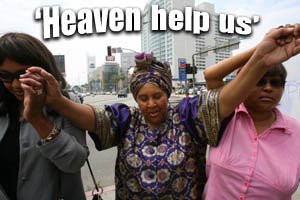
The Rev. Beatrice Williams drove 110 miles to Hollywood on Wednesday to beg the Lord for lower gasoline prices.

"There is victory when we stand together," Williams said, after joining eight others in prayer. "We will overcome, and we will overcome this if there are enough people who believe that God cares."

Standing beneath the Gothic Revival tower of Hollywood United Methodist Church - and across from a Chevron station charging $3.43 a gallon for unleaded - the group asked God to comfort those paying more while driving less.

"We give you praise and honor and glory. You are king of all kings. You know our needs," Bishop Donald Downing, pastor of Heart to Heart Christian Center in Fort Washington, Md., prayed as cars zipped through the intersection of Highland and Franklin avenues, occasionally honking.

"These high gas prices, Lord, bring them down, oh Father."

These prayer warriors were hoping to induce the same miracle the effort's organizer, Pray Live, claims it brought about in Washington, D.C. After about 50 attended a gathering in late April, national fuel prices dropped a few cents.

Californians, however, continue to see prices sky high. A gallon of regular averaged $3.39 in Los Angeles on Wednesday - down, but just a penny from Tuesday.

"This will be a testament to all of the people who don't believe in the power of prayer," said Wenda Royster, director of Pray Live, which operates a 24-hour phone and Internet prayer line.

"Gas is almost like water, especially here in California, where people drive far to work and can't rely on public transportation."

Gasoline experts have been offering advice for months on how drivers can reduce fuel prices: empty the trunk, combine errands, keep tires properly inflated, maintain a steady speed.

"People seek - what is the word I'm looking for? - relief in many ways," said Jeff Spring, a spokesman for the Automobile Club of Southern California. "We would recommend they continue to try to cut their use of gas to try to lower the prices. Reduced demand will lower their prices."

What about asking for help from above?

"I'll leave that question up to the theologians," Spring said.

In Scripture, God's children tend to pray for illnesses to be healed and for persecution to be stopped, said Patrick Miller, professor emeritus at Princeton Theological Seminary.

"Situations that evoke people's crying out to the Lord - what I would call prayers for help - tend to be situations when the community is in dire straits," Miller said.

But rising gas prices are different because it's possible God is reminding Americans the world has limited natural resources, Miller said. Praying to overcome human excess would be like praying to ace an exam that wasn't studied for.

On the other hand, it would be appropriate to pray for wisdom to respectfully live in God's creation and conserve natural resources, Miller said, which was why the Rev. Ed Hansen agreed to have Wednesday's prayer session outside his church.

"It is very unjust that profits can be so high when people are so deeply affected," said Hansen, who drives a 2004 Prius and lives a mile from his church. "From a faith perspective, I believe God wants us to work for justice."

While Hansen said some people at United Methodist are struggling to pay rent or put food on the table because they're paying steeper prices for gas, ExxonMobil, the world's largest publicly traded oil company, reported a record profit of $8.4 billion in the first quarter of this year.

The national average for a gallon of gas rose again this week, closing at $2.93 on Wednesday.

The prayer group didn't expect God's answer to "come down in a lightning bolt" but to lower prices over time by guiding politicians on energy policies.

Not everyone was a believer, though. Holding signs calling people to prayer, the group was unable to lure any passers-by into its fold.

"Pray for lower gas prices?" a twenty-something man said, cocking his head as if confounded by a great riddle. "I'll think about it," he said, deadpan, and hurried off.

Friday, May 12, 2006

This one is uplifting

From: Los Angeles Daily News
www.dailynews.com

Sergie Mendoza makes $60,000 a year customizing cars at a Canoga Park garage - an income that in most places would afford him a middle-class lifestyle.

Instead, Mendoza plans to move his wife and two children to a place where the American dream costs a lot less.

"We're going to move out of here. We're going to Florida," said Mendoza, 34, who's already sold his Northridge home. "It's too hard to live here. Everything is too expensive. You can't survive."

Californians such as Mendoza are increasingly finding it harder to make ends meet, according to a Public Policy Institute of California report to be released today.

The study is also critical of the criteria for the federal poverty line, which is based on income and doesn't take into account the cost of living in a specific region.

After adjusting for home prices, the percentage of Los Angeles County residents living below the poverty line increased from 15 percent to 18 percent, placing it among the 10 highest-poverty counties in the nation, the study found.

California's ranking among the states and Washington, D.C., rose from 15th to third.

"We don't have a realistic picture of how many families are struggling to make ends meet in California, which is particularly true in Los Angeles," said Deborah Reed, the study's author and director of the institute's population program.

The study also attributed California's hidden poverty to the nation's largest immigrant population and to growing income inequality.

Incomes have fallen 4 percent for low-income families since 1969, while rising 16 percent for middle-class and 41 percent for upper-class families.

And what is average costs a lot more. In the past year, for instance, San Fernando Valley home prices soared 17 percent and apartment rents 9 percent.

In addition, the Los Angeles Department of Water and Power has proposed raising water rates 3.9 percent this year and 3.5 percent next.

Mayor Antonio Villaraigosa is pushing a 64 percent trash-fee hike.

And nobody needs to be told that gas prices - among the highest in the nation - are through the roof. The local average for unleaded is now $3.39.

"There are millions of people in L.A. County who are not affording the basic necessities to support their families. It's obvious in the crisis we are seeing in housing and education and, of course, health care," said Jessica Goodheart, co-director of research at the Los Angeles Alliance for a New Economy.

The federal government's formula for calculating the poverty line - devised four decades ago by the Office of Management and Budget and used by the Census Bureau - is adjusted for inflation but doesn't account for disparities in costs for utilities and real estate markets.

The poverty threshold for a family of four was $19,157 in 2004, the most recent year statistics were available. That year, landlords could charge low-income tenants $12,252 in Los Angeles, which experts say doesn't go far in booming Southern California.

"Right there, if you are paying the fair-market rent, 64 percent of your income would go into that rent," Reed said.

Needy Californians also are less able to qualify for anti-poverty programs, such as food stamps and Head Start, because their income is more than 80 percent above the poverty line.

For example, almost 2 million Californians participated in the federal Food Stamp Program last year, second only to Texas. But in New York, with a population little more than half of California's 38 million, 1.75 million people received food stamps.

In Louisiana, which has a lower poverty ranking when adjusting for housing costs, 18 percent of the state got food stamps in 2005.

Today's report is the latest to criticize the federal poverty line. In 1995, the National Academy of Sciences recommended that the poverty-threshold formula take into account food, clothing, health care, housing and utilities.

"The saddest part to me is watching the young people have to work full time, go to school and every penny they make is going to cover their rent - nothing more," said Toni Gorton, a Woodland Hills psychotherapist.

"I think we can kiss the middle class goodbye."

Thursday, May 11, 2006

The House We All Grew Up In ...


From: Los Angeles Daily News
www.dailynews.com

The archetype of San Fernando Valley architecture is a small house with a peach wooden-panel exterior, tall windows and that classic ranch look.

Like much of the Valley, Violet McCallister's Studio City home was built in the 1950s. It looks nondescript, even plain, but it still draws an international audience.

"There isn't a day goes by that there isn't a looky-loo or someone taking pictures," said McCallister, who with her husband bought the home in 1972, during the fourth season of "The Brady Bunch."

"Last week, 7 o'clock at night, some girl knocked on the door. Is this the Brady Bunch house?'"

"Yes," McCallister answered.

"Oh good. I'm from Arkansas. I've been looking all day for this house," the girl responded. "Do you mind if I take a picture?"

Few, if any, San Fernando Valley homes can claim such fame. But just as Gutenberg is known for the Bible and Edison for the lightbulb, the Valley is known for its collection of tract homes.

"The incentive to create mass suburbs," said urban historian Joel Kotkin, "was greater here and happened faster than elsewhere. When other suburbs began to grow at the same rate, they followed the model that the Valley did."

That can be seen in Long Island, N.Y., which bloomed with new communities a decade behind the Valley; outside Atlanta, which is now one of the fastest growing areas in the country; and in Sun Belt cities like Las Vegas and Phoenix.

In the Valley's first town, there were Craftsmans and Queen Annes, Spanish Colonials and Mission Revivals. Built along the Southern Pacific Railroad in the late 1800s, the city of San Fernando has homes more common to urban L.A. than the suburbs.

Valley development followed in patches, with communities like Van Nuys and Tujunga and Woodland Hills separated by vast farmlands and citrus groves. Those gaps were filled in the late 1940s and '50s as thousands of World War II GIs looked for pleasant neighborhoods to start their families, and Valley construction took off.

"Because of the federal-housing guarantee and the loans available to veterans, the dream of owning your own home became a reality," said Kenneth Breisch, director of the University of Southern California's Architectural Preservation Program.

The 1,000-acre Panorama Ranch was the site of the Valley's first master-planned community. Made to order with schools, a hospital and industry, Panorama City was a forbearer of the low-slung, tract homes that would epitomize new developments across the semiarid floor. A $500 down payment could secure a two-bedroom home on a tree-lined street.

The community's success would earn one of its creators, Fritz B. Burns, the designation of "Mr. Housing, U.S.A.," according to James Thomas Keane's biography of the L.A. developer.

For others involved in the home-building process, the Valley was a canvas with plenty of room for them to leave their mark.

Edward H. Fickett, an architect whose signature is on thousands of homes like those in Meadowlark Park and Sherman Park in Van Nuys, is remembered for drafting blueprints with the passion of an artist and the pragmatism of Henry Ford.

"He isn't remembered as an architect for designing one particular house," said Chris Hetzel, editor of preservela.com. "He is remembered for defining housing as we know it."

Fickett convinced developers that people would spend more for a house that looked less cookie-cut.

"I call it Modernism for the Masses," said Ken Bernstein, director of preservation for the Los Angeles Conservancy.

Fickett plans were a riff on ranch houses. They had grown popular in the run-up to war thanks to cowboy-actors like Roy Rogers, who lived on a Chatsworth ranch. That style would go mainstream with the housing boom, when land seemed more limitless than air.

"The ranch house was quintessentially anti-urban," Breisch said.

Many houses were built with floor-to-ceiling glass. Floor plans were open and utilized the Southern California climate. They had a backyard and, for the fortunate, the iconic swimming pool.

"That, is traditionally suburbia," said Sherwood Schwartz, who in 1969 chose the Valley for the setting of his television show, "The Brady Bunch."

The irony is that the Brady house was not quite as it appeared. It was difficult enough for six kids to share one bathroom; imagine that in a one-story, two-bedroom house. So Schwartz had a faux window added to the wall above the garage to give the curb-appearance of a second floor. The show was filmed on a Burbank set.

The house — myths aside — came to embody the ideal of a quaint suburban life, of a place where a lovely lady and a man named Brady could raise a happy, if utopic, blended family.

Added Schwartz: "That was the Valley in those years."

Sunday, April 30, 2006

Where's the Weed? -- Everywhere.


From: Los Angeles Daily News
www.dailynews.com

The plainly labeled brown door on the second floor of a Studio City office gives no indication of the marijuana being sold inside.

Valley Collective Care keeps the deadbolt locked. Inside sits an armed security guard; another watches over the stock. There is a surveillance TV in the lobby, a few copies of Amsterdam News and a white poster board with the handwritten message of the Fourth Amendment, protection from warrantless searches.

Between 11 a.m. and 7 p.m. daily, patients walk in with a slip of paper and an ID, and a few minutes later leave with a cure for what ails them.

Valley Collective was one of the first medical marijuana dispensaries in the San Fernando Valley when it opened last August. Now there are at least 20 in the Valley, with about 50 operating countywide and more than 200 throughout the state.

"This is the wild, wild West. Everybody is just trying to stake their claim," said Scott H. Linden, a Pasadena attorney who has helped several Valley dispensaries open.

Ten years after voters approved Proposition 215, legalizing marijuana for medicinal purposes, these pharmacies operate with little oversight.

Advocates maintain fairly comprehensive databases, but government officials, including those of the Los Angeles Police Department and the county's public health chief, don't even know how many dispensaries exist.

All it takes to get started are a few easily obtained business licenses, a willing landlord and a list of doctor-recommended patients such as Fritz Weaver, 44, of North Hollywood.

"I can function on pot and it doesn't destroy my liver," said Weaver, whose doctor told him to find an alternative to Vicodin for chronic back pain. "It's a no-brainer."

Cannabis clubs, or co-operatives, have been the source of controversy. Patients like Weaver have come to rely on them for comfort, but communities have taken a decidedly different view.

Because they house massive amounts of cash and thousands of dollars worth of marijuana, dispensaries have been targeted for smash-and-grab burglaries; Valley Collective had computers and an undisclosed amount of cash taken March 29. Some co-ops also have been accused of selling to people without prescriptions.

Seeking to limit such problems, some Northern California communities - including San Francisco and Oakland - have moved to regulate where, when and how these clinics operate.

Pasadena and 19 other cities have outright banned them.

And nearly 60 cities - including Simi Valley, Moorpark, Long Beach and West Hollywood, which already had seven - have enacted moratoriums on new dispensaries.

L.A. County Supervisors are scheduled to vote May 9 on a law to allow dispensaries in unincorporated areas, though not within 1,000 feet of schools, youth facilities, churches and parks. The proposed law would also require specific signage, proper lighting and security guards.

Sgt. Lee Sands, a Los Angeles police spokesman, said there has not been a trend of criminal activity occurring around cannabis clubs. The city has no regulations planned.

"Dispensaries must be regulated," said John Furry, founder of Weedtracker.com, which reviews co-ops based on their level of "compassion" for sick and dying people. Low marks fall to those places that overcharge because they know someone will pay.

"Many of these operators are in it just for the money," said Richard Eastman, an AIDS patient who in 1996 helped open L.A.'s first dispensary. "How could someone on Medicare or Social Security afford $20 a joint?"

Federal laws still consider it a felony to grow, sell or use marijuana. The U.S. Supreme Court ruled last June that Californians could be federally prosecuted for using marijuana - even if it was allowed under the state's Compassionate Use Act of 1996.

That means agents with the Drug Enforcement Administration could come knocking on Valley Collective's door any day. That's one reason co-ops keep close to the chest the names of their owners and employees.

DEA has performed dozens of raids during the past five years, the biggest and most recent on 13 dispensaries in San Diego in December. In many cases, paraphernalia has been confiscated but charges have not been filed.

Twenty people involved with medical marijuana have been convicted on drug charges since Proposition 215 passed, according to Americans for Safe Access. The DEA's office in Los Angeles couldn't verify that. To them, there is no distinction between using marijuana recreationally or medicinally - both are illegal.

But agents can't just shut down dispensaries the moment they open, said DEA spokeswoman Sarah Fenno.

"If you read in the paper someone was selling meth out of their house, we couldn't just go and arrest them. We would still have to conduct an investigation and obtain a search warrant or an arrest warrant to identify the players involved," Fenno said.

The Food and Drug Administration entered the politically charged arena April 20, when it said "no scientific studies supported medical use of marijuana."

That was endorsed by the White House Office of National Drug Control Policy, which interacts with DEA.

"We certainly don't want the absolutely fraudulent claim that this is some therapeutic medicine to sweep in here and confuse people about the risk that they are running when they take marijuana," Dave Murray, special assistant to the drug czar, said in an interview last week. "This is not a proven medicine. It has not been approved by the FDA."

This has caused much grumbling in the medical-research community.

"It's politics and not science that is driving the train here," said Dr. Donald Abrams, a professor of clinical medicine at University of California, San Francisco, whose studies have shown marijuana benefits some AIDS patients.

To many, the FDA's statement seemed to ignore a 1999 review by the Institute of Medicine, an arm of the National Academy of Sciences. That 288-page report found marijuana to be helpful with certain cancer and AIDS patients, particularly those having problems eating.

"There is an awful lot of scientific evidence," said Dr. John Benson, co-chairman of the review committee.

Cannabis sativa, as marijuana is known medically, has been found most beneficial for treating chronic pain; muscle spasms, such as those caused by multiple sclerosis; the physical wasting away of AIDS patients; and chemotherapy-induced nausea and vomiting.

Eastman, 53, of Hollywood was experiencing the wasting. Since contracting HIV in 1994, Eastman has been at death's door several times. Anti-retrovirals are keeping him alive, but they strip him of his appetite. Some AIDS patients literally starve to death.

Eastman didn't want to beat the disease, only to die from the treatment.

Early on he remembered that smoking marijuana as a teen had given him the "munchies," that stoner struggle to fill an insatiable hunger. Eastman's daily routine consists of taking protease inhibitors to combat the now-undetectable AIDS eight times a day and smoking marijuana twice, shortly after he wakes up and again two hours before bed.

"About an hour and a half ago, I smoked some medical marijuana, which is helping me eat this now," he said over a bacon-and-eggs breakfast.

"When we got the law in '96, I thought we'd won. Why do I still have to keep fighting 10 years later?" Eastman asked.

The debate over medical marijuana has been running for more than a century and a half.

Marijuana was introduced into western medicine in 1842, Abrams said. It was a legal, if unsavory, substance until four years after Prohibition ended. In 1937, marijuana had been identified as the drug of jazzmen and Mexican farmers, and Congress moved to outlaw it.

At hearings before the House of Representatives, the only opposition to the Marihuana Tax Act came from the American Medical Association, which thought cannabis cultivation and consumption should remain legal but be regulated.

"The AMA stood alone in opposing it because they believed there was no real evidence it was harmful and they believed it would impede further studies," Abrams said. "And they were right about that."

In 1942, cannabis was removed from the U.S. Pharmacopoeia. It wasn't until 1986 that the FDA approved Marinol, a synthetic concentrate of the ingredient THC. Many patients dislike Marinol because it takes longer to enter the bloodstream and is more potent when it does.

"People don't know what it is about," said Gerardo Servin, a 20-year-old Glendale man who uses marijuana for an anxiety disorder. "They just think people are medicinal cannabis users because they want to smoke pot. Every day people look at me and they judge me."

While some of the estimated 150,000 cannabis patients statewide have their prescriptions written by a family physician, like Servin did, many travel hundreds of miles to visit one of the self-proclaimed pot docs.

Many of these 35 physicians, who are listed on the Web site of the California chapter of the National Organization for the Reform of Marijuana Laws, specialize in cannabis-related cases.

Referrals can be found on other Web sites, too. Weedtracker.com has an advertisement at the top of every page that lists a phone number and reads: "Medical Marijuana Recommendations." The 877 number connects to the West Hollywood office of Dr. James Eisenberg, who declined interview requests.

During the past decade, the California Medical Board has disciplined four physicians for prescribing marijuana without a thorough examination. Eisenberg was not among those disciplined.

Once the prescription has been written, patients choose their co-op.

They are called co-operatives because, by law, the dispensary can only have a half-pound of marijuana in stock for every patient on its rolls.

Many of these places resemble "drug dens," said Linden, the attorney who has helped open dispensaries.

"It has started to turn around. The places I'm working with now are more professional," he said, echoing a common refrain of the six co-ops visited.

"When you walk in, it should be the same thing as walking into a doctor's office. That's how it should feel. It should be professional."

INSIDE A CANNABIS CLUB

One of the San Fernando Valley's newest medical marijuana dispensaries sits in a black stucco building, adjacent to the Xposed full nude club.

Racy business cards for the club and next-door bar, The Wet Spot, are stationed throughout the inside of Collective Caregivers pharmacy, which opened in Canoga Park in late March.

Inside is "Taylor," a tall brunette with red and blonde highlights, a nose ring and a deep tan. On a recent day, she was wearing a black Korn T-shirt knotted to reveal six inches of midriff, a belly-button ring and a butterfly tattoo on the small of her back.

Once a patient has been cleared, Taylor, who doesn't "do last names," presses a button that unlocks the pharmacy door.

They enter a temperate room with two jewelry-display cases, an ATM and a safe with 4-inch-thick steel. The dispensary sells smokeable leaves and candy edibles: Peanut Butter Cup, Cannabis Cookie and sugar-free milk chocolate candy bars. Marijuana buds come in 20 varieties, such as Tidal Wave, Train Wreck, Organic Grapefruit Haze.

The $10 candy bars, labeled "Keep out of the reach of children," have several grams of fat and half a gram of marijuana.

The leaves are grown across the state, said Brad Barnes, who identified himself as the general contractor, and cost $15 to $30 a gram.

Collective Caregivers is open seven days a week from 11 a.m. to 11 p.m., about three hours later than any other dispensary in the Valley.

Barnes insists the co-op is just for those who qualify under state law.

"You can't just say, `I want to get some bud today' and walk in here," Barnes said. "This is a medical office. It doesn't look like you are walking into a 1970s head shop: There are no beads on the wall, no orange shag carpet."

Tuesday, April 25, 2006

Ditch the car?


Michael Bernheim’s solution to soaring gas prices will cost you $1,000.

It has four wheels, weighs 52 pounds and is covered in grip tape. It’s a 40-inch-long skateboard that runs on electricity and has a top speed of 22 MPH. It’ll take you 14 miles before its batteries need to be recharged. “Refueling” takes three hours, but it only costs about 20 cents.

“You don’t have to have insurance; it’s nonpolluting; it’s portable. And you can carry chicks on it,” said Bernheim, co-owner of California Motors Co.

On the niche company’s website, which is on the free and popular networking site, MySpace.com, Bernheim is marketing the electric-powered skateboard as a practical alternative to high gasoline prices.

The average price for a gallon of unleaded fuel in Los Angeles has mushroomed 53 cents during the past six weeks. Feeling the pinch at the pump has become cliché. Many Americans are seeking gimmicks, buying gadgets and simply gabbing amid their quest to afford the unbudgeted expenses.

In fact, there are many things that do increase fuel efficiency. The Environmental Protection Agency recommends drivers avoid quick acceleration and braking, properly inflate tire levels and drive at or below the speed limit, among many driving and maintenance advice.

But veer wide of what John Millett of the EPA calls “bogus contraptions” – gizmos that can be added to the fuel line or air filter. In 30 years, EPA tests have only found one that improved gas mileage, and that technology has since been incorporated into most vehicles.

As for the Fuel Genie, Platinum Gas Saver and Tornado Fuel Savers, “Don’t waste your money,” Consumer Reports said in November. “They don’t work.”

A motorized skateboard could help someone struggling with gasoline prices, said Carol Thorp, a spokeswoman for the Automobile Club of Southern California. “But given the commutes of most people, is riding a motorized skateboard a rational answer?”

It is for Bernheim, who uses his board to get to the grocery store, the library, the movie theater. If a business doesn’t want him lugging the board through their shop, he checks it like a bag.

Sometimes he skates the 10 miles from his Santa Monica house to Beverly Hills, where he is the marketing director for The Balance Disorders Institute of Los Angeles. While he works, the board’s batteries recharge.

Growing up in Burbank in the 1960s and ‘70s, Bernheim was an avid skater. He still looks the part: slate gray Pumas, light jeans, a plain, blue T-shirt, large Ray-Ban sunglasses and shoulder-length, wavy red hair.

As a teen, he rigged a board with a four-stroke lawnmower engine and another with a two-stroke weedwhacker engine. They proved cacophonous and precarious.

Two years ago, he and two partners decided to build their own skateboard engine and power it with two twelve-volt batteries. The engine purrs yet is powerful enough to climb Coldwater Canyon in Studio City, as Bernheim demonstrated Monday. The throttle and brakes are controlled by a remote plastic handle.

California Motors has sold 72 boards nationwide to people like Katie Hall, 20.

Several times a week, Hall drives from her home in Burbank to Cal Poly Pomona, where she uses her motorized skateboard to get around the hilly campus.

Obviously Hall couldn’t trade in her car for her skateboard with that 70-mile roundtrip commute. But what about using her board to get around Burbank?

“I'll ride it up and down my streets and stuff,” Hall said. “But I wouldn't use it for a different form of transportation if I was going to the mall or something because where am I going to park it?”

Monday, April 17, 2006

Pass the Matzo

From: Los Angeles Daily News
www.dailynews.com

Michael Deering ate the bitter herbs, broke the matzo and partook in the Seder meal as Passover began Wednesday evening.

For more than 3,000 years, Jews have celebrated Passover to remember their deliverance from slavery in Egypt.

But Deering is a lifelong Catholic - and he's among a growing number of Christians who attend Seders to connect with their religious roots and to draw parallels to their deliverance from sin.

"Any Christian who doesn't know our Jewish roots is an incomplete Christian," said Deering, 55, of Granada Hills.

"The Passover is more of the Exodus story; that was the birth of the modern Jewish nation," said Deering, one of more than 200 people at a Seder at St. John Eudes Catholic Church in Chatsworth. "Jesus was tied into it through being the sacrificial lamb to wash away our sins."

The Seder began with the "mother" of each table lighting a candle that represents the spiritual joy of God's promise to the Israelites. Monsignor Peter Nugent explained to the goys what each object on the Seder plate represented - the bitter herbs of slavery, the nuts and apples of hard work, the unleavened bread of people on the run, among other items.

They filled their glasses with wine and after Nugent sang in Hebrew, they drank the first spirits of deliverance. Three more sips followed.

"Each of us, each generation, is a beneficiary of God's power of salvation," the people said in unison. "For this reason we raise our cup."

The two-hour Seder could have been celebrated in a synagogue just as easily.

"As an educational tool to learn about Judaism, that is great," said Rabbi Cheryl Peretz, associate dean of the Ziegler School of Rabbinic Studies at the University of Judaism. "Being able to see it for what it is as a Seder, not creating something that isn't Jewish out of it."

The divergence from Jewish tradition, obviously, is made with the inclusion of Jesus.

The Last Supper of Christ and the Apostles was itself during Passover, at which Jesus gave the bread and the wine new meaning to his followers.

"You really can't understand the Communion if you don't understand the Pesach (Passover)," said Mark Brewer, senior pastor of Bel Air Presbyterian Church, a 2,300-member congregation that sits above Encino on Mulholland Drive.

Communion, or what Catholics call the Eucharist, is the remembrance of Christ through eating his body (bread) and drinking his blood (wine or grape juice).

Brewer said Passover is heavy with Christian symbolism: the striped matzo representing the scourges of Jesus; Father, Son and Holy Spirit seen in the three matzos; the sacrificial lamb that spared the Jews' firstborn from the Angel of Death.

"We understand the Passover through the eyes of Jesus," Brewer said.

That's why most of Bel Air Presbyterian's congregants are participating in Seders with their Bible studies. The text provided by the church was written by two members with Jewish heritage.

Glendean Thompson is accustomed to attending Jewish Seders. On Friday - Good Friday - she will host her first.

"It has so much meaning for a Christian," said Thompson, a Woodland Hills psychotherapist who leads a small Bible study. "Christianity is a Jewish faith."

Other groups, like Betsy Cramer's, are trading the gefilte fish and unleavened bread for food a bit more American.

"We're calling it a fake Seder dinner," Cramer, 26, of Sherman Oaks said of their trip Tuesday night to Hamburger Hamlet, where they read through materials provided by Bel Air Presbyterian.

"We certainly revere our Jewish friends, but we didn't think we had to go fully out to embrace the tradition," Cramer said. "Plus, all of us are so gentile. We were like, 'Where do you get a rack of lamb?"'

Sunday, April 09, 2006

Is This a Good Investment?

From: Los Angeles Daily News
www.dailynews.com


Tens of thousands of hopeful real-estate moguls entered the Convention Center on Saturday with money on their minds.

They were drawn to the two-day Real Estate Wealth Expo by iconic investors like Rob "Rich Dad" Kiyosaki, Donald Trump and Magic Johnson.

Many wanted to know how to make their first million, and the program covers assured them, in block red letters, "THIS WEEKEND CAN MAKE YOU A MILLIONAIRE!"

"You do not have to have money. You don't have to have good credit. You don't have to have a job. All you need is the knowledge to put a deal together," Reggie Brooks told students in a session he taught on investing in abandoned properties.

A high school dropout, Brooks was living in South L.A. and making $36,000 a year at Pacific Bell when he attended a Learning Annex real-estate class taught by Albert Lowry. Eighteen years on, he's still buying abandoned properties. He believes he is transforming community eyesores while making a pretty penny.

Attendants were over and over reminded of such success stories: middle-aged men and women who had left steady jobs and, following a speaker's tips, had struck paydirt investing in real estate.

But, at a time when the once-blistering housing market is cooling, others warn that flipping properties isn't going to carry the profit it recently did, particularly in California.

"Wealth doesn't happen overnight," Vince Malta, president of the California Association of Realtors, said in an interview Friday. "This is a market that is well balanced. It is great for the homebuyer. It is not great for the investor who is looking to hold on for a short period of time."

The expo, which runs through 8 p.m. today and costs from $179 to $499, began in 2004 as millions of Americans found themselves trying to capitalize on a soaring housing market. Organizers anticipate 55,000 visitors, enough to fill the Staples Center next door almost three times.

"What a turnout! This is fantastic!" Hall of Fame basketball star and urban investor Earvin "Magic" Johnson said as he spoke to a 23,000-seat auditorium half-full of people. "I wish the Lakers got this many people."

Johnson told people to dream and be patient. He was rejected by the first 10 investors he approached about opening franchises of Starbucks, 24 Hour Fitness and TGI Fridays. The 11th shared his vision - and helped launch a $700 million empire.

"If I had stopped," he said, "I wouldn't be here today."

The Learning Annex spent $2.5 million to have Donald Trump promote the expo on freeway billboards, full-page newspaper ads and TV spots.

"If you're a first-time buyer or a serious investor, this event will change your life," Trump said in a commercial during March Madness.

The well-known real-estate mogul, whose return to fame has been fomented by the popularity of the reality-TV show "The Apprentice," will be paid $1.5 million to share his wisdom for one hour tonight.

Kiyosaki, author of "Rich Dad, Poor Dad" and object of a cultish following, also will speak today."Chase has read all his books," John Boulter of Orange County said about his 14-year-old son, who said the expo will help him become a millionaire.

"If I start (investing) now, I can probably do it by the time I'm 25," Chase said.

Everybody is selling something. Keynotes and seminars were just the beginning. The truly apt pupil was inspired to spend several hundred dollars on additional training materials.

"Compare that to a Harvard MBA," Brooks said, referring how much cheaper it would be to spend $895 on his program. "One little abandoned property can make you so much money and you don't have to have a big student loan."

A Grief Preserved


From: Los Angeles Daily News
www.dailynews.com

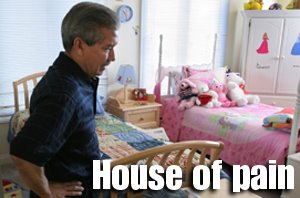
Despite its five bedrooms and view of the Pacific, this sprawling hilltop home feels like a prison to Dr. Xavier Caro.

It is here that his then-wife, Cora, lost in their loveless marriage, ended three young lives and shattered his.

Now he's trapped in the Santa Rosa Valley north of Thousand Oaks by pride and a court order.

After Cora was convicted of murdering three of their four sons and sentenced to death, the trial judge ruled that her share of the couple's affluence should be used to pay for the two public defenders who represented her. Ventura County billed her $307,000.

But Dr. Caro, a prominent Northridge rheumatologist, has fought the county, arguing that the woman he divorced forfeited her wealth when she destroyed their family.

And so he stays in his house - their house - to prevent the county from enforcing its lien against the property.

"There are no words," Caro said recently over coffee in his kitchen. "There are no experiences that compare. Only a parent who has lost a child can empathize. To have that act triple is even more painful.

"To have the perpetrator be someone who is so close to you and to have accusations that you were the cause be aired in public is even more painful.

"Having the county ask you to pay the tab for that humiliation is just beyond words."

The house is tastefully furnished with an antique piano and a gorgeous leather chess table. Chess, photography and Caro's medical practice keep his mind busy.

He lives here with Gabriel, the only son who survived the 1999 shootings, and the belle he plans to marry in June.

But now he has to decide if he will subject his fiancee to living in a beautiful home with monstrous memories or if he'll sell the residence and risk losing the money.

The Caros' assets are still tied up in family court. California's community-property laws entitle Socorro "Cora" Caro to half, but her ex-husband won a $45 million wrongful-death suit against her. A judge is deciding who will get what.

Technically, the county is trying to collect from Cora Caro. A judge prevented her from spending $500,000 on a private attorney because Xavier Caro had filed for divorce after the boys' deaths.

The Public Defender's Office spent 3,350 hours defending her. One of their arguments was that Dr. Caro killed his kids and framed his wife.

"I don't mean to be tunnel-visioned," Public Defender Ken Clayman said recently. "But the county spent a fortune on her defense and deserves to be reimbursed for it."

The laws are clear, Clayman said: Half of what was theirs is hers.

"My sense is Cora isn't entitled to anything," counters Xavier Caro. "That is where the moral argument trumps technical argument."

Caro is a small, fit man, with a confident air, gray hair and tanned skin. He was the family breadwinner; she was his office manager.

Cora helped balance his profession, but early on she made his personal life a soap opera, he says.

She was prone to violent eruptions - both at home and at work - and she eventually drove him into the arms of another woman.

On the night of Nov. 22, 1999, they had a typical fight. Cora blew up, Xavier stormed out.

He returned home three hours later, climbed the stairs to the second floor and found his wife face down. She had shot herself in the head.

"Are there children in the house?" the 911 operator asked him.

He hadn't thought about it. The house had been so quiet, Cora so still. He found Joey first, and then ran to the room Michael and Christopher shared. Each had been shot.

"Michael was still alive, but he was in his last moments," Caro recalled. "When I picked him up, his skull came off in my hand."

Only Gabriel, then just 13 months old, was unharmed.

Sheriff's deputies and paramedics arrived and found Caro's wife breathing.

She recovered and stood trial in 2002. She was convicted and sentenced to death, which she is awaiting at the California Correctional Facility for Women in Chowchilla.

Xavier Caro quickly filed for divorce and sued for the wrongful death of Xavier "Joey" Jr., 11; Michael, 8; and Christopher, 5. The suit was stayed, pending the conclusion of the murder trial.

Before Caro won the largest judgment ever issued in Ventura County, the Public Defender's Office filed a motion to be paid for its work.

"What she did, as horrible an act as it was, doesn't affect her property rights," said Matthew Smith, an attorney for Ventura County. "No one is asking him to pay for her lawyers.

"What we are asking is that she pay for her lawyers."

The county won its judgment first and placed a lien on the Santa Rosa Valley home and the couple's vacation cabin in Northern California.

The bill, with interest, has grown to about $410,000.

Dr. Caro and Prisoner No. 13 are legally divorced.

Caro won't sell the house until Judge John R. Smiley divides their assets. If he sold first, the equity from the house would be locked in an escrow account, which is what happened when the city of Waterford enacted eminent domain on his vacation property two years ago.

The Santa Rosa Valley house has been described in news accounts as a mansion.

It was this man's mansion, but by Southern California standards it was simply a beautiful abode - 4,800 square feet that overlook the exclusive and expensive valley, where a street sign greets drivers and cautions "Children and Horses at Play."

The Caros paid $672,500 for it in 1993. It came with privacy, sweeping canyon vistas and a picturesque view of the Channel Islands framed by the valley walls.

"It's a very lovely neighborhood. We don't have any trouble here," Darlene Dickinson, who lived nearby, told the Daily News after the murders.

Not until four years later could Xavier Caro sleep here. He spent six months in a hotel and then rented a house in Westlake Village.

He was trying to escape the horrors, but he couldn't stop the flashbacks - the silence of a still house, Cora's bloody handprint on the wall, the boys' bodies neatly tucked in their beds and resting on bloody pillows.

Caro, 58, and Gabriel, now 7, continue to receive counseling each week. "The Boy," as Caro refers to his surviving son, was diagnosed with anxiety caused by early separation from his family.

His father often shares stories of his brothers but hasn't yet told Gabriel what happened to them.

"He feels his brothers are still around," Caro said. "Sometimes he tells me he talks to them."

Their pictures remain throughout the house, which Caro almost lost in July 2003 when Ventura County scheduled it for auction. But once the county learned Caro and his son had returned earlier that year, it decided not to move for eviction and called off the sale.

They've been stalemated since, with the county offering undisclosed settlements and the doctor holding out on principle.

"It doesn't look like I am going to prevail against the county," Caro said. "But I personally feel this is so morally wrong I have to say something."

Along the road to recovery, Caro met Ruby Monje. She moved in and brought her daughter.

Stephanie, 7, and Gabriel share the bedroom where Michael and Christopher slept. Joey's room has been turned into a study and game room.

Caro wants more children and he believes Monje, who is in her late 20s, will be a good mother. He's at peace with the house and could stay there indefinitely. But she's not.

"It would be healthy for all of us to move to another home and start anew," Monje said.

"We want a stable environment where our children are going to be happy and safe."

Tuesday, March 21, 2006

Lost in Transportation


From: Los Angeles Daily News
www.dailynews.com

It's an airline traveler's biggest headache: They're headed from Point A to Point B but their luggage ends up ... well, somewhere in between.

That happened with an estimated 30 million bags worldwide in 2005, according to an industry report released Monday. About 200,000 were never reunited with their owners.

The percentage of bags that were mishandled - about 1 percent of all luggage - represented a 43 percent increase from 2004. That cost the airline industry about $2.5 billion - $900 million more than the year before, according to a report by SITA Inc., a company that produces luggage tracking technology.

Increased traffic, tighter connection times and added security are blamed for the increased number of lost bags.

But industry officials were quick to note that unfortunate travelers typically get mishandled luggage within 24 hours. But American Airlines spokesman Tim Smith acknowledged, "all the statistics in the world don't matter at all if it is your bag."

After 90 days, most of the major U.S. airlines sell retrieved luggage to the Unclaimed Baggage Center, a 40,000-square-foot Alabama department store that "Good Morning America" has called "one of the biggest tourist attractions in the state." The baggage center pays an undisclosed amount regardless of the bags' content.

The center sold about 1 million items last year, said spokeswoman Brenda Cantrell, "everything from nail clippers to a diamond ring."

Eight years ago, Unclaimed Baggage Center found a real gem: a 5.8-carat solitaire diamond ring that appraised for $46,000. They sold it for half price.

Cantrell has noticed, however, that the center comes across far more men's wedding bands than women's.

Airports also make a little extra money when bags are left in airport common areas. LAX has a warehouse on Century Boulevard where it holds discarded luggage for 97 days. After that, a bag's clothes are donated to area shelters and valuables are sent to the LAPD property department in Van Nuys and auctioned off.

About 2,000 items - laptops, cell phones, jewelry and wallets lacking IDs - were sold, said airport spokesman Harold Johnson. The income generated is not separated from the auctioning of police seizures.

The much smaller Bob Hope Airport in Burbank got $1,932 from an unknown number of auctioned items in the fiscal year that ended June 30, 2005.

To reduce the risk of losing luggage, airline officials advise travelers to label their bags on the outside and inside, double-check the flight tag placed on their bags and arrive early. Most importantly, don't pack things you can't afford to lose: cash, jewelry, medicine.

If you are flying domestically, however, there is a far lesser chance your bags won't travel with you than SITA reported worldwide. The Department of Transportation reported this month that about seven of every 1,000 passengers on domestic airlines in 2005 reported mishandled baggage - less than one-tenth of a percent of travelers.


The Associated Press contributed to this report.

Saturday, March 18, 2006

A Golden Year


From: Los Angeles Daily News
www.dailynews.com

Jim Altmann fell asleep on a recent night thinking about his mother's victorious claim that she - not the Austrian government - was the rightful owner of five Gustav Klimt paintings worth about $300 million.

He dreamed his family was sitting in the living room of his mother's Los Angeles home when the doorbell rang. It was UPS. They had the paintings.

"I called my mom and told her about the dream," said Altmann, 50, of Agoura Hills. "And she said, 'You're not too far off. They're going to ship them to the L.A. County Museum of Art."'

The Klimt paintings that Maria Altmann knew as an Austrian girl left Vienna this week for Los Angeles, where her family found refuge after escaping the Nazis almost 70 years ago.

But the paintings are not the kind to be hung above the mantle. On April 4, they will be exhibited at the Los Angeles County Museum of Art, where they will remain through June.

"Eventually, they will be sold to museums or the appropriate people so they can be seen," said Altmann, the 90-year-old "Klimt Warrior," as her sons call her, who sued Austria on behalf of herself and four other heirs.

The paintings are believed to be the largest restitution ever ordered in a Nazi-looting case. They include the 1907 gold portrait of Altmann's aunt known as "Adele Bloch-Bauer I," which is valued at $120 million and is considered one of Klimt's two best pieces.

LACMA, which asked to hold the exhibition, is working with Altmann and the other four heirs to keep the paintings on "permanent display," said Stephanie Barron, the museum's senior curator of modern art.

"We can hope," Barron said. "There are a lot of very wealthy people in Los Angeles."

Klimt, who was born in Vienna in 1862 and died in 1918, was a personal friend of Altmann's aunt and uncle, the Bloch-Bauers. They were one of three families who owned most of his paintings.

Ferdinand and Adele Bloch-Bauer were part of Austria's wealthy Jewish community during the early 20th century. He was a sugar magnate, she a Social Democrat who mingled with leftist politicians, artists and intellectuals.

They couldn't have children. Their wealth was willed to two nieces and a nephew. Altmann is the only one still living.

When Adele Bloch-Bauer died in 1924, she left all her property to her husband but asked him to bequeath their art collection to the Austrian National Gallery at the Belvedere Palace.

Before he died, though, Nazis seized the Bloch-Bauer possessions and property, including the Klimt paintings, which had hung in Adele's bedroom as a memorial.

The paintings became a source of pride for Austria. One of the country's most important artists, Klimt's work is erotic and suggestive, distinguished by gold backgrounds and mosaic patterns. He was known to spend a year or more on some pieces.

"The paintings give us a sense of the power of art at the turn of the century in Vienna," Barron said. "They are glorious, intimate, psychological and astonishingly beautiful paintings that transport us to another time and place."

Altmann, the daughter of a lawyer, had grown up with maids, cooks and a butler. But she was largely unaware of their wealth.

In 1938, Altmann's father died naturally and her husband, Fritz, was placed in a concentration camp. When the paintings were stolen later that year, Altmann said, "I couldn't have cared less."

Eventually, Fritz escaped. He and his wife fled, settling in Los Angeles in 1942. They began socializing with other Austrian Jewish refugees and put together a familiar life in an unfamiliar land.

Fritz worked for his brother's cashmere sweater company; Maria ran a Beverly Hills women's boutique. But they didn't live like the Bloch-Bauers had.

"When I was a little boy, my mom showed me a reproduction of this painting," Jim Altmann, the youngest of four, said about the gold portrait. "My mom said, 'If my aunt would have left us this painting, our lives would have been totally different."'

Thirty years ago, Altmann moved into a simple one-story house on a quiet street with a coastal breeze. Her Cheviot Hills backyard is quintessential Los Angeles: a pool and a view of the Pacific. The interior is decorated with antique statues and paintings. But there is no place for a real Klimt; besides, Altmann already has that "Adele I" lithograph - not to mention the portrait's place on wrapping paper and a coffee mug, which Altmann finds "tasteless."

Klimt was a contemporary of Sigmund Freud and Arnold Schoenberg, the famous composer and grandfather of E. Randol Schoenberg. Altmann was a close friend of the younger Schoenberg's maternal grandmother and has always seen him as family.

"Randy" was 32 when she called him with hopes his mother could provide legal advice in recovering the Klimt paintings. It was 1998 and Austria was considering - and eventually passed - a law that required the National Gallery to return any donations made in exchange for having other property seized by the Nazis returned.

Schoenberg's parents were vacationing in Vienna and the young lawyer quickly found himself taking on the case. It was all-consuming.

"My night job was a lot more fun," he said of the unbilled time he spent on the Klimt case. "It was the kind of thing you could talk about at cocktail parties and everybody would be interested."

All his client ever wanted was for the Austrian government to acknowledge that the paintings still belonged to her family, Altmann said. She made a plea for an apology as late as during a 1998 meeting with Austrian officials in Vienna. When they walked, she sued.

The case went through the courts until reaching the U.S. Supreme Court in February 2004. When the court ruled that Altmann could sue Austria, Schoenberg suggested they instead have the case decided by three Austrian arbitrators. He didn't want a U.S. court to issue a rule in their favor and have the Austrian government balk.

"We really were looking at an endless and hopeless procedure in the U.S. until the Austrian government agreed to the arbitration," said Schoenberg, who attended Harvard-Westlake when it was Harvard School.

Now 39, he's argued before the U.S. Supreme Court (winning the rare right to sue a foreign country), he's won an unprecedented case (proving that five national treasures didn't belong to that nation) and he's secured himself a seemingly large reward (though he and Altmann declined to discuss the specifics).

"It turned out my night job was actually much better than my day job. Who knew it?" Schoenberg said. "Everybody just thought I was nuts."

Saturday, March 11, 2006

My Date with The Donald


From: Los Angeles Daily News
www.dailynews.com

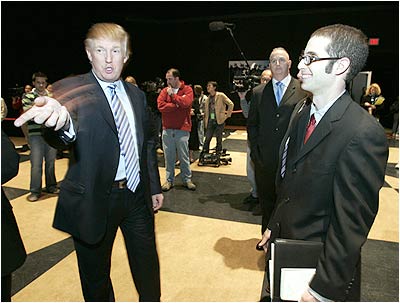
UNIVERSAL CITY - You just don't turn down a job interview with Donald Trump - not even if you're a newspaper reporter instead of an wannabe executive.

Trump was in Southern California on Friday to promote a 17-city casting call for the sixth season of the NBC reality show "The Apprentice," which will be filmed in Los Angeles for the first time.

A contact at NBC had arranged for my interview to be done by The Donald himself, so I worked late Thursday on my application and resume. I needed something extra to wow Trump and become one of 16 cast members. But even a magician can only do so much with "student, intern, reporter, reporter."

My printer failed about five minutes before midnight, and I made a quick run to Kinko's. I managed to get four hours of sleep before getting myself ready and driving to Universal City, arriving before 6 a.m., even though NBC had said not to.

About 25 people were ahead of me when I stepped into line at 5:44 a.m. It was so cold that Farrah Evagues was wrapped in a gray blanket as she sat in a pink folding chair at the head of the line.

"We left Orange County at 2, got here at 3 and then drove around for an hour trying to figure out where we were supposed to be," said Evagues, a 23-year-old director of operations for an Anaheim military-electronics company. Her mom was waiting in the car.

The line quickly grew to several hundred. But this being Los Angeles, hundreds of others had mailed in taped submissions.

Back in the line, dressed in a black suit and red T-shirt that read "future billionaire," was Jon Cronstedt, 24, a mortgage division manager from Orange County who lamented that interest rates were rising and his list of prospective clients was shrinking.

"The Apprentice," he said, would broaden his career opportunities.

"You watch three seasons of the show and you figure, Why not?"

Also looking for a career change was math teacher Bill Newyear, 58.

"An MBA is fine. Young and energetic is good. But an old dog can learn new tricks," said Newyear, a silver-haired teacher at New Vista Middle School in Lancaster who "would leave teaching in a heartbeat because the 250 grand or whatever sure beats the snot out of what teachers make."

Then there was David Schwartz, a 43-year-old artist from Oxnard, who already has plans for Trump City, "a fascinating place, very futuristic" that supposedly is being planned for the moon.
"My creative ideas can not only help the Trump industry but help the world," said Schwartz, who wore a black beret, tattered, paint-covered blue jeans and a jacket and tie.

Shivering next to him was Eric Mark, a business consultant from Marina del Rey who got a call-back interview when he auditioned in San Diego for season four.

Mark thinks he has a real shot of making the final cut this time and is ready for the reality TV ordeal: "It certainly takes a certain kind of person, the kind who enjoy challenges and humiliation."

After nearly four frigid hours outside, my back aching, I got into the warmth of the replica Globe Theatre. There were five tables inside a large room. Most had 10 applicants and two casting directors asking the questions.

My table had nine hopefuls - and Trump.

We had a former Miss Yugoslavia, an investment banking wunderkind and a 30-year-old once worth $60 million but now almost penniless, save the gold Rolex he kept as a memento from his salad days.

TV crews and their blinding lights surrounded us. I knew I was going to do something stupid. After introductions, which were humbling at best, Trump asked us to debate whether dating should be allowed among colleagues.

"If Mr. Trump were dating one of the contestants, I'd see a problem with that," said Alex, the kind but unsmiling investment banker from Goldman Sachs.

Trump and his casting producer based their picks on the way candidates interacted during the debate and articulated their points. I was at a loss, drowned beneath the din of a few dominating voices. I quickly learned how frustrating it must be to actually be on this show.

After about five minutes, Trump asked each of us to fire someone. Miss Yugoslavia, the first to decide, said something about "glasses" and pointed at me.

Scott Salyers, the casting major domo, told the group to avoid giving this journalist the boot. I asked that I not be treated special.

"Well, then, everybody is going to pick you," the amiable Salyers said.

Charles, who is still in college, was the other offender to finger me. I soon returned the favor.

"The first thing he said was, 'I'm interested in business.' I don't want someone who isn't interested in business," I said. "I want someone who knows business."

"You did say that, Charles," Trump nodded, validating my contribution.

And like that, 10 minutes after it started, our interviews were over.

We were told that everyone selected for a follow-up interview in May would be called by the end of the day. "So leave your cell phones on," Salyers advised.

Before I left, I pulled Trump away from the cameras and asked what I had been dying to know: How did I do?

"You did great," he told me.

It was 11 a.m. I went home happy. And I waited.

My phone never rang.

Drowned Dreams


From: Los Angeles Daily News
www.dailynews.com

Kimberly Pandelios moved to Northridge from Florida so her husband could try his luck as a drummer. And so she, too, could seek fame and fortune.

Kim was an aspiring model with limited success sporting one-piece bathing suits and lingerie. Responding to a model-wanted ad in a local weekly, the 20-year-old mother drove into the Angeles National Forest to meet a photographer she knew only as Paul. She wanted the gig; her family needed the money.

She awoke that Thursday - Feb. 27, 1992 - with stars in her eyes. The mercury reached 87 degrees, the month's hottest day, and the sun shone brightly - ideal conditions for an outdoor photo shoot.

After taking her 13-month-old son, Nicholas, to a baby sitter, she drove to the Sherman Oaks home of a woman trying to start a men's lifestyle magazine. Kim was going to appear on its first cover. From there, she visited a salon en route to meeting Paul.

"Then," Los Angeles County sheriff's Detective Stephen Davis said, "she fell off the face of the Earth."

Peter Pandelios grew worried when his wife wasn't home for dinner. Paul had called at 2:30 to confirm his appointment with Kim and phoned again about 7 to say she had left her planner. But Peter thought he had to wait 48 hours to report her missing.

About 2,300 miles away in Reading, Pa., Magaly Spector learned of her newlywed daughter's disappearance but knew she hadn't run away. "I thought she had an accident," she said. "I went crazy. I called every hospital in L.A. I called funeral homes. I just went crazy."

Late that night, an off-duty police officer cutting across Angeles Forest Highway on his way home spotted a small fire in the passenger seat of a Chrysler Laser near the Monte Cristo Campground. By the time firefighters arrived, flames had engulfed the sports car. It was registered to Kim Pandelios of Northridge.

Over the following year, Kim's family feared the worst. A distraught Peter initially drove aimlessly about the city, hoping to spot his wife by chance. Exhausted, he crashed his car, abruptly interrupting his search.

Magaly kept developing empty theories to justify her daughter's disappearance. "One day I was thinking she was alive, and one day I was thinking she was dead."

A ringing phone was a fleeting celebration. She always answered with the expectation of hearing Kim's voice. It wasn't until March 1993 that she got the call that ended her optimism: Two gold miners had found a human skull and bones in the brush near the site where the Chrysler was found.

Investigators discovered handcuffs nearby and a black bra and panties that had been cut off.

"The whole thing collapsed," Magaly said - her theories, her hopes, herself.

Watching the evening news that night, Brad Leon saw Kim's photo and was convinced she was the same doe-eyed blonde he had seen a year earlier at the same site.

An off-road enthusiast, Leon had been driving along the dirt roads near the old Monte Cristo Gold Mine when he found a path new to him. He drove down it about 100 feet before encountering a makeshift camp.

There he made eye contact with a beautiful woman dressed for another occasion. It was a Saturday, two days after Kim disappeared. Suddenly, his Baja Bug was surrounded by three men he described as outlaw bikers, with long hair and tattoos.

"What's your problem, man?" one of the men repeatedly rasped as the three shook Leon's Bug. He sped out, not realizing the woman needed him, he said on a 1995 episode of the TV crime drama, "Unsolved Mysteries."

"If she would have given me an indication she was in trouble, of course I would have done something. But I didn't know," Leon lamented. "This person basically died because of my inaction, because of my ignorance."

The segment ended with host Robert Stack saying, "Kimberly's family and the Los Angeles County Sheriff's Department hope that the man named Paul, or someone who knows him, is watching our broadcast tonight. The authorities would like to emphasize that Paul is not a suspect but that he could be pivotal in solving this case if he still has Kimberly's missing appointment book."

A year later, Linda Sobek, a former Raiders cheerleader and swimsuit model who had posed for Playboy, was raped and murdered. There were uncanny similarities between her death and Kim's: They were brunettes posing as blondes; they were last seen alive going to photo shoots; their remains were found in the Angeles National Forest.

Authorities quickly identified Charles Rathbun as Sobek's killer. A photographer who cleaned up taking pictures of busty babes with sexy cars, Rathbun got life in prison without the possibility of parole and a made-for-TV movie. He was identified as a suspect in Kim's murder, but there was no evidence, except coincidence.

Investigators still hadn't located Paul.

David Rademaker had seen the "Unsolved Mysteries" episode about Kim. He told his girlfriend the theory posited on the show was wrong. And he believed the cops knew it and were trying to convince the killer to lower his guard and start making mistakes that would lead to his arrest.

It marked the second time Rademaker, who was in his early 30s at the time, had mentioned the young model's murder to Manya Ksendzov, his 15-year-old girlfriend. He previously told her he had been a person of interest in Kim's death because authorities found his phone number on her phone bill shortly before she vanished.

The third time it entered conversation proved a bit more frightening. On the phone, Ksendzov told Rademaker she was tired of being manipulated for sex. She wanted to date someone her own age.

He didn't take well to that idea and threatened to start sexual rumors about her, according to court testimony. He also warned her that she might suffer at his hands like the young model he raped after she resisted his advances in the forest.

Rademaker reminded Ksendzov of the trip they had made a few months earlier into that forest, how they pulled off the highway after driving for a while, and he wandered off. She assumed he had gone to urinate, but he told her he had been surveying the site where he drowned Kim and that he found one of her leg bones.

"He said ... she was pleading with him to let her go, that she wouldn't press charges, that she would just pretend it hadn't happened because she wanted to go home to her kid," Ksendzov recently testified.

She thought he was lying, trying to scare her. And it did, but not enough to report anything until her family sought statutory rape charges against him two years later. Even then, Rademaker was not named a suspect or arrested in Kim's murder.

Across the country, Kim's mother, brother, widower and son were trying to move on.
Nicholas had immediately returned to Pennsylvania to live with his paternal grandparents, with whom he still resides. After a few months, Peter left his job filling vending machines and returned to the Schuylkill Valley.

"It's something I'll never get over," he testified last month. "I'm the guy whose wife got murdered. That's who I'll always be."

Kim's family had moved to Reading, Pa., when she was 9. She was born Hossanna Spector on Nov. 13, 1971, in Cuba, where her father's Jewish family landed after fleeing the Communists in Russia. It was an ill-timed move, but that's where Roberto Spector met Magaly Bernal.

In 1980, they traded Castro for Jimmy Carter and immigrated to the United States on the Mariel Boatlift. It was a dangerous mission for the family, particularly because Kim's mother had become a national chess champion at a time when chess boards were the intellectual battlefield between Communist countries and democracies.

"I brought her here from Cuba to give her freedom and opportunity - and I lost her," said Magaly, who was completing her doctorate in physics when Kim's remains were found. Today, she is a global manager for Lucent Technology and is one of the leading Latina females in the United States, according to Hispanic Business magazine.

Kim was a cute kid with a wide smile, glowing cheeks and curly brown locks. In photos, she appears years beyond her age. But she seemed ashamed of her roots, friends said. She changed her name, wore blue contacts, dyed her hair.

"Image was very important to Kim, from her blond hair, to not keeping her name of Hossanna, to making sure everyone believed things were great for her," said Julie Chisholm, who as a child lived in the same apartment complex as Kim and spoke with her regularly as an adult.

After graduating from high school, Kim enrolled at Pennsylvania State University. She talked of becoming a computer scientist, but one night she visited a club where the band Gandolf was performing. She was smitten with the drummer, a skinny guy with long, wavy black hair.

She left Penn State to start a family with Peter. They briefly moved to Florida, where they married and Nicholas was born, before moving to Los Angeles in November 1991. Kim told Peter he had a few years to make a name for himself as a musician, her mother recalls. "If it doesn't work, we will go back," Kim said.

Her friends, though, thought Kim would become famous first, with her tanned skin and golden hair that hung to the waist of her 5-foot-2, 100-pound body.

"She was gorgeous," said Stephanie Stamm, an art teacher and hand model. "I figured ... Victoria's Secret will be next."

But L.A. wasn't LaLa Land. Money was tight, and Kim had an itch to return to school. She began looking into enrolling at California State University, Northridge. She was also burdened by the struggles of marriage, Chisholm said.

"She was more likely to call me when she wanted to complain," said Chisholm, who spoke with Kim just days before she was murdered. "She was not happy where her life was."

In late 2003, Sgt. Mike Robinson of the sheriff's cold-case homicide unit peered into the Kimberly Pandelios case and thought there were some workable leads. He asked Detective Thomas Kerfoot to look into it. Kerfoot asked for the assistance of Detective Davis, who had been one of the initial investigators.

Thumbing through old reports, Davis found a statement from Manya Ksendzov that piqued his interest. In a follow-up interview, Ksendzov told him that her ex-boyfriend, Dave Rademaker, had bragged of raping and murdering Kim.

Ksendzov was worried, too. The January 2004 interview occurred 13 days after Rademaker had been paroled. He had served six of his 12 years for his sexual relationship with Ksendzov during the mid `90s and for providing her with heroin.

She was eager to help the detectives; too eager, defense attorneys would later argue.

With Ksendzov's statement, Davis and Kerfoot began building a case against Rademaker, a 40-year-old registered sex offender who once ran a teen party line called The Zoo and lived with his parents in a small, hillside home in Burbank.

He was known to plant fliers for the phone line - like a pre-Internet chat room - at area junior high and high schools.

"Girls would call in and he'd get them hooked. Then he'd take away their user code so they would have to meet him to get it back," said Carlos Bas, a 42-year-old North Hollywood man who encountered Rademaker in the party-line underworld.

Flipping through an old LAPD missing-persons book, Davis found Rademaker's name listed as the boyfriend of a Cynthia Haddon during the time Kim was murdered.

He made several calls before he got Haddon's number.

"I've been waiting quite a while to talk," Haddon responded to Davis, according to court testimony.

She went on to explain that her ex-boyfriend had taken her into the Angeles National Forest on a February night in 1992 because he wanted to torch a sports car he had seen on the side of the two-lane highway.

Haddon agreed to use a special cell phone that would record her conversations with Rademaker. She had been asked by police to get him to talk about the night he torched Kim's car. And he did.
But in a dozen recorded conversations and one taped face-to-face meeting in a Denny's parking lot in Lakewood, Rademaker adamantly denied killing Kim. Arson would be his third strike under the state's "three strikes, you're out" law, and Rademaker assumed he was going to serve life in prison when Haddon told him she had spoken with police. Even then, though, he denied being a murderer.

"I didn't kill her - that's ridiculous," he said, according to the recording.

In their last phone conversation, Rademaker begged Haddon to meet him in person again so he could explain what happened in the forest. He spoke frantically and said he didn't know if he should commit suicide.

It wasn't safe for Haddon to meet him again, the detectives decided. It was time to make an arrest. They would go with the evidence they had.

"This is a bittersweet victory," Sheriff Lee Baca declared at a news conference outside sheriff's headquarters in April 2004. "The satisfaction is knowing we solved the case through bulldog investigative police work."

The monthlong trial began in January. It was more "Law & Order" than "CSI." There was no DNA, no new technology that helped crack the 14-year-old case. It hinged entirely on witness statements - specifically those from Ksendzov and Haddon. District Attorney Steve Cooley wanted the death penalty, and put two of his top prosecutors on the case.

Ksendzov testified that Rademaker had bragged about the murder. She talked about his strange sexual proclivities. And she said he had used aliases for his escort business - among them, Paul.
The defense saw Ksendzov as the prosecution's linchpin. Unlike with Haddon's testimony, which was rooted in recorded conversations with the defendant, they attempted to paint Ksendzov as a biased witness, a former heroin addict bent on seeing her ex "burn in hell."

"She blames him for using her, for getting her into drugs, for killing her successive boyfriend because he OD'd on drugs," defense attorney Chad Calabria said in his closing statement.

Defense attorneys argued that her story was inconsistent. She talked about Rademaker's escort service, but said he was faithful to her; she said he had an affinity for anal sex, but that they rarely engaged in it.

Lastly, the defense noted that in 1998, Ksendzov told two Los Angeles police detectives that Rademaker said Kim was one of his hookers, that he had had sex with her before sending her on her final assignment. Kim's family vehemently denies that she was involved in the sex business.

The defense called Brad Leon to testify about the incident he described on "Unsolved Mysteries," but the prosecution argued that while Leon was well-intentioned, it was not related.

Rademaker did not take the witness stand. His parents didn't come to his defense. (Neighbors said the Rademakers had not been seen for weeks, and a phone message left with his sister was not returned.)

The jury of eight men and four women deliberated for almost four days.

The verdict: guilty. First-degree murder with a special circumstance of kidnapping. Rademaker was sentenced Tuesday - 14 years and one day after Kim was murdered - to life in prison without the possibility of parole.

Kim's family flew into Los Angeles the day after he was convicted. The next day, Feb. 17, the family sat in a cold and largely empty ninth-floor hallway at the downtown courthouse. That's where Robert Spector, Kim's younger brother, spent his 23rd birthday.

Her father wasn't there. Roberto Spector had lost touch with his daughter and son after he and Magaly divorced in 1989. Nobody told him about the trial.

"Was he convicted of killing her? Was he sentenced to die yet?" Spector asked in a phone interview. "I'll be really happy to hear that."

Family members waited three hours before Magaly was called to the witness stand during the trial's penalty phase. Over the following two hours, the family explained how the defendant's actions shattered their lives. Then they spent the three-day weekend holed up in The New Otani Hotel in Little Tokyo. And they waited.

After penalty-phase closing arguments Feb. 23, Magaly, her husband and her grandson traveled to the murder site. Riding shotgun heading up Highway 2, Nicholas commented on the natural beauty of the rugged mountains.

"But this is really out there," said Nick, now 15. "I'm definitely thinking this would be a good place to kill somebody."

He has grown up without a mom. The closest thing he has to memories of her come from the home videos he watches with Magaly when she picks him up for the weekend once a month.

"I can remember just, like, a car or something like that. A flash here and there," he said.

The Monte Cristo Campground is about 15 miles north of La Caada Flintridge. Kim's family and Detective Kerfoot stopped at the ranger station to connect with Detective Davis and two Forest Service officers, who led them into the scrub oak, chaparral and manzanita where Kim's remains were found scattered about, likely by an animal.

"This is the creek where he drowned her?" Magaly asked.

She bent down and laid six white roses and a framed photo of Kim on a rock above the water. Then she began to read her daughter's favorite poem, "Los Zapaticos de Rosa" by the Cuban intellectual Jose Marti, which she remembers Kim reciting when she was young.

It sounded like Magaly was crying out for Kim to return as she sobbed through the 64-line poem. She bent down to the shallow creek, which Davis said had been a "rolling river" when Kim was drowned, and washed her hands.

"Listen to that water running: It is her life," Magaly said.

"I know how she was born ... and now I know how she died. And I know her soul is around - she went back to nature."

Hasidic Rhymes

From: Los Angeles Daily News

From: Los Angeles Daily News
www.dailynews.com

NORTHRIDGE - His lyrics and his appearance are clearly Hasidic, but fans of Matisyahu's reggae rhymes are Jews and gentiles alike.

In a black suit and hat and boasting a long beard, Matisyahu entertained a packed crowd Thursday evening in the parking lot of Tower Records with bumping rhythms and punchy rhymes as he promoted the release of his new album, "Youth."

"He's a great inspiration to our people," said Dora Arzhevskiy, a 23-year-old Liberal Jew from West Hills.

"He shows us you can keep your faith and still rock on," volleyed her 20-year-old brother, Eli.

Rock station KROQ-FM (106.7) passed out kosher candy to a diverse crowd not often drawn to a single concert: Hasidic Jews, Rastafarians, clean-cut parents and metal maniacs.

"I like how a Jewish guy can come out and bust into (expletive) reggae and not care what anyone has to (expletive) say. I love that," said P.J. Morrison, a 22-year-old metalhead from Tujunga.

Amazed by Matisyahu's performance on a late-night TV program, Rosemary Wilkins and her husband dragged their 15-year-old daughter, Kathryn, to the reggae artist's free show.

"She's not a huge fan yet. But we go to all her concerts," said Wilkins, a Chatsworth resident, giving Kathryn a nudge.

Matisyahu fed the 2,500 crowd with a five-song set that closed with his hit single, "King Without a Crown," which has been shown on MTV and has saturated radio airwaves.

"Sing to my God all these songs of love and healing/Want Mashiach now so it's time we start revealing," Matisyahu rapped, asking for God to send the Messiah (Mashiach).

His music has been written up in Rolling Stone and The New York Times. Critics wonder whether he is a pioneer or a fluke. Despite a gaggle of journalists begging his publicists for a sound bite Thursday, Matisyahu declined any interviews.

And some critics wonder how seriously they should take the message of his music.

Despite Matisyahu's reggae sound, Rastafarians did not dominate the crowd - and neither did the smell of marijuana.

"Do you think he'd be bummed that he has a fan who's a stoner?" quipped one 21-year-old Calabasas fan who openly puffed on a joint.

Born Matthew Miller, Matisyahu grew up in White Plains, N.Y. He didn't embrace his parents' Judaism, and by age 14 he was wearing dreadlocks and Birkenstock sandals. He spent class time perfecting the art of beat-boxing - making percussion sounds from the mouth - and as a junior he almost burned down his chemistry lab.

That led Matisyahu on a spiritual journey to the Rocky Mountains, where he discovered God and the inspiration to make his first trip to Israel.

But when he returned to New York, Matisyahu felt empty, according to his Web site. He didn't know how to prolong the religious experiences he had had in Colorado and Israel.

So he dropped out of high school and followed the jam band Phish around the country. That ended when the money, and his energy, ran out.

After two years at a wilderness school in Oregon, Matisyahu enrolled at The New School, a liberal arts university in New York, and began writing plays and working on his music.

He also discovered Hasidism and committed his life to the Jewish lifestyle. His music is infused with religious themes, mixing reggae rhythms with Jewish beliefs.

"I doubt that everybody gets the references. But what they definitely get is the passion that is directly connected to religiosity," said Rabbi Tsafreer Lev, who teaches Jewish philosophy to seniors at New Community Jewish High School in West Hills.

Lev's class is studying Hasidism and an upcoming assignment is to write an essay about all the Hasidic references in "King Without a Crown."

"I had him on my iPod before he was the number one requested song on KROQ," said Lev, who was tutoring at the University of Judaism on Thursday night. "I tried to spread the word, but nobody really listens to rabbis."

Sunday, November 20, 2005

God-given gold teeth?

Source: The Sun in San Bernardino.
www.sbsun.com

SAN BERNARDINO -- If Jesus could turn water into wine, why wouldn't God turn teeth into gold?

A growing number of people at Highland House of Prayer are claiming he has. It began with a series of religious revivals in October. Now, much of the congregation is opening wide and pointing to shiny dots on their teeth.

That was gray, they say, but now it's gold. Others have crowns and caps that appear to be wholly gold or maybe holy gold.

"The Lord spoke to me and said, 'It didn't have anything to do with faith. I did it to increase your faith.'' said the church's pastor, Larry Baker. "It has done so for me and this church tremendously.'

God only knows what's really going on, but about 15 of the church's 70 members say their teeth or fillings have turned to gold during the past three weeks. Some are now on a mission to get their dental records and prove their claims are true.

Across the world, Pentecostal Christians like those at House of Prayer claim teeth have changed, the disabled have been healed and the dead have been raised.

For now, the spirit is moving at House of Prayer. The congregation meets in the Church of Yahweh, a blue and white building in a dark Base Line strip mall, a few blocks west of the Highland city limits.

Since October, Baker and visiting evangelists have asked church members to show their faith by giving money "sacrificially.' Youths responded by selling their video games and basketball-card collections, a church bulletin reports, and adults sold second vehicles and wedding rings.

The church offering, which averages about $3,500 per month, surpassed $25,000, Baker said. An unspecified amount went to the evangelists; the remainder was earmarked to help build their own church, the pastor said.

Then God began paying through the teeth.

Baker was at home enjoying dinner with his family when the phone rang.

"I have a gold filling where I didn't have one,' the woman on the line told him.

"We told her to come over,' Baker said. "I didn't realize I already had mine.'

A few friends arrived at Baker's San Bernardino home to see what they couldn't believe. Jamen Nicholson, an area minister and contract painter, turned to the pastor and said, "I guess you already got yours done.'

"I turned to my wife,' Baker recalled, "and I said, 'Is there gold in there?' She went very, very white.'

Since then, he claims, God has given him four more gold teeth and one that is silver. He plans to visit his dentist Wednesday to get his records and to have his teeth checked. He wants to know if they are capped or solid.

Theologians say the purported miracles are nothing to pooh-pooh.

"We never say, 'It can't be real,' because God is God,' said Doug McConnell, dean of the School of Intercultural Studies at Fuller Theological Seminary in Pasadena. "I'm not a dentist, but I would assume a dentist could say, 'Yeah, it wasn't there before and it is now.''

About 84 percent of Americans believe in miracles, according to a 2003 Harris Poll. But things more commonly considered miracles include cancer disappearing, money appearing and, generally, prayers being answered.

"Healings take place now because God and Jesus have healed in the Bible,' said Robert Bruce Mullin, author of "Miracles and the Modern Religious Imagination.'

"I don't know of any place (in the Bible) where God turns lead teeth into gold teeth,' Mullin said.

Baker said that God was replacing their amalgam fillings, which are about 50 percent mercury, with a safer metal.

"What God simply did was do away with the mistake of man and do it as only God can do it,' Baker said.

Although mercury is poisonous, there is no evidence that the fillings are hazardous. The American Dental Association has defended the safety of amalgam fillings, which have been used for 100 years.

Some religious commentators urge caution before claiming miracles.

Many believe, but they are being deceived by a "counterfeit revival,' says Hank Hanegraaff, president of North Carolina-based Christian Research Institute and host of the Bible Answer Man radio program.

"The expectations of people have reached such a fever pitch that some time ago a parent who lost a child put his baby on ice and drove 350 miles to the Brownsville Assembly of God to have the baby raised from the dead,' he wrote in a recent essay on the institute's Web site.

These stories have "tragic' consequences, wrote Hanegraaff, who was traveling Friday and unavailable for further comment. "When followers finally catch on to the manipulations of revival leaders, they often become disillusioned and disenchanted.'

Whether the fillings are safe or not gold or gild they have energized Baker's small congregation.

"In the Bible, you read about it, people raising from the dead, people being made to walk, but today you don't see it, except some televangelist twenty-nine, ninety-five for a healing handkerchief,' said James Wynn, 18, of San Bernardino. "But that's not real. Then you see it happen to your friends and family. It's amazing.'

And what's in Wynn's mouth?

"I have a filling that hasn't turned to gold yet,' he said optimistically.

Wednesday, October 26, 2005

Sculpting an identity

Source: Inland Valley Daily Bulletin
www.dailybulletin.com

DIAMOND BAR -- The football coach hollers, "Water break!" and the players cluster around blue Powerade bottles. Hytham Elsherif stands alone and to the side.

"Somebody soak him down," an assistant coach says.

He unstraps his helmet so a teammate can squirt water on his head. He spits repeatedly to keep it from sneaking into his mouth.

Hytham is a unique member of Diamond Bar High School's varsity team -- he is its only Muslim. Because it is Ramadan, the holiest month of the Islamic calendar, Hytham is fasting from sunrise to sunset each day.

Starving the body for 14 hours is taxing on even the most sedentary. For a 17-year-old offensive lineman, it seems like a death wish.

"If he wants to play, it's up to him," says his mother, Naglaa Elsherif. "But he has to follow God's rules -- he has to fast. If he doesn't have the energy to fast, don't play."

Hytham's is a common dilemma of Muslim-American youths, many of whom find themselves attending class, studying and competing athletically on an empty stomach one month a year.

A first-generation Egyptian-American, Hytham has sculpted an identity as an American youth who happens to be a devout Muslim. He is one of an estimated 10 Muslims in a sea of 3,307 students. But his classmates do not consider him particularly different -- except during that one month each year when they only see him eat at night.

During Ramadan, which this year began Oct. 4 and ends Nov. 3, the 1.3 billion Muslims worldwide who are of age, in good health and not pregnant are called to abstain from food, drink, cursing and sex during the day.

Fasting is one of Islam's Five Pillars. Hytham first participated at age 6. He says it gets easier as the month progresses, that his body adapts to his inability to make up the lost calories.

The coaches and players say they respect Hytham's religion. His conviction leaves them in awe. But they are not without concern for the effect it has on Hytham's performance.

Take Jeff Jansen. As starting quarterback, Jeff's safety from injury largely depends on the offensive line's ability to block defenders.

Jeff worries that Hytham doesn't have the energy on game day to protect him. Against Chino High School, Jeff notes, he was sacked eight times.

"The previous five games I was only sacked once. And then he started doing his fasting thing."

-----

The yellow buses arrive at Chino High at 5:32 p.m. The players step off and into the visitors' locker room. They are anxious. Their team is 3-1-1 and they are up against one of the favorites to win Sierra League.

Hytham hasn't eaten or drank anything for more than 13 hours -- and all he had then was a bagel and a glass of orange juice.

"I'm feeling good," he says.

Hytham is 6 feet 2 inches tall and built like a Buick, his undershirt bulging with muscles and belying his youth. His hair is short, his skin bronze, his eyes calm. Black face paint runs in a C-pattern from both eyes, along the jawbone to the corners of his chin.

His weight has fallen this month from 247 pounds to 226. And more than a week of daytime fasting remains.

"We're undersized," he says. "But we work hard and we hit hard and we work as a team. That's what helps us win games. A team's gotta have heart."

The Brahmas head to John Monger Stadium to warm up.

As the sky's blue fades, and the clock passes 6:30, Muslims throughout the Western U.S. break fast. Hytham is running plays.

Coach calls them in. They huddle and return to the lockers.

"Hytham! Your food's here," linebacker Danny Carrillo bellows.

Hytham gulps a 34 oz. orange Gatorade and then walks to the water fountain. He refills the bottle and empties it again. He grabs a granola bar and, as soon as he finishes that, pops a banana into his mouth.

Other players adjust their pads and get retaped.

Chino makes quick work of their opponents and scores on its fifth offensive play. Clearly, Hytham is not the only Brahma struggling to get into the game.

At the half, the score is 21-0.

In the locker room, Hytham grabs a Gatorade. The athletic trainer tries to hand him a paper plate of spaghetti, a sandwich and some orange slices, but the scoreboard has stripped his appetite.

"My stomach's too tense to eat," he tells the trainer, Stacy Camou.

"You're playing weak. You feel like you don't have to eat, but you have no fuel," Camou responds.

He begrudgingly accepts an orange slice. Camou's not happy either. She asks an intern trainer to grab the food and take it to the sideline in case Hytham gets hungry during the second half.

He eats no more.

The game ends 41-0.

-----

Coach Nick Cuccia's team meets in his classroom on Tuesdays and Wednesdays to watch films of that week's opponent.

Two days before facing Damien High School, desktops are covered with potato chip bags and soda bottles. Players wolf down burgers, burritos, sandwiches. The smell of seasoned french fries saturates the room.

Hytham, clad in blue jeans and a black Cal State Fullerton hooded sweat shirt, twiddles his thumbs, his fingers interlocked atop an empty desk in the front row, his back to most of the munching.

He awoke at 4:50 this morning, had a light breakfast -- bread topped with a spread of feta cheese, tomatoes, cucumbers and olive oil -- and prayed before sleeping for another hour.

By 6:55, he was with his teammates in the high school's weight room, working his legs and lower back for the next hour and a half.

"He's one of the hardest lifters on the team," Cuccia says.

Leg workouts are exceptionally strenuous because they demand energy from so many muscles, which shocks the central nervous system into releasing testosterone and growth hormone and increasing overall muscle growth. But a workout needs to be followed with food if muscles are going to grow.

"If you don't have anything afterward to replenish, you are basically eating away at your muscles all day," says Rehan Jalali, a Muslim and former bodybuilder from Irvine who recommends people fasting exercise at night.

But Hytham says his stomach is too small and his time too tight.

In fact, during the first few nights of Ramadan, he made the mistake of bloating his stomach with water, which stopped him from eating.

Little, if any, medical research has been done on the effects of daytime fasting on athletic performance. Anecdotally, it is perceived to have a negative effect -- but one that can be mitigated.

"You just have to come up with strategies to make up for the calories you're not getting during the day," said Dr. Sameer Dixit, UCLA Primary Care Sports Medicine fellow.

Such strategies include eating large meals in the morning, waking up throughout the night for refueling and avoiding strenuous activity shortly before sunset.

Hakeem Olajuwon and Muhammad Ali made it work. They were role models to many young Americans, especially Muslim youths who wanted to excel at sports without compromising their religious beliefs.

Dixit, a physician for UCLA football, said coaches should watch for signs of dehydration if a player is fasting -- cramps, lightheadedness, headaches, blurred vision, nausea, fatigue.

"The running is what kills me because I can't drink anything, so I get really dehydrated and I get headaches," says Hakam Halabi, a 6-foot-3-inch, 270-pound defensive end on Diamond Bar's freshmen squad. "I'm not really hungry but I'm really thirsty -- very thirsty."

Speaking during practice, Hakam explains that during Ramadan he participates in only the least exhausting drills and doesn't play in games. Fasting connects him with his religion, he says, but it distances him from football. His mouth is parched. His lips look chapped.

"You cannot break fast for weakness, but if there is a legitimate reason" -- such as extreme dehydration -- "you can break fast," said Imam Farid Hasan, head of the Islamic Center of Rialto. "It's not supposed to be a hardship. It's supposed to teach you self-restraint."

-----

Legends are made when athletic ability appears uncanny. For instance, when NFL Hall of Fame running back Walter Payton died in 1999, every credible obituary mentioned Nov. 20, 1977 -- the day Payton, ailing with the flu, set a single-game rushing record of 275 yards.

Michael Jordan in 1998 played through a stomach flu and scored 38 points to lead the Chicago Bulls to victory in Game 5 of the NBA Finals.

"Certainly, there are people who can place mind over body," Dixit said. "It is something we have no explanation for."

Hytham's teammates don't either.

"It doesn't mix," says starting running back Joe Beaudion. "He's half man, half amazing."

Arinze Anih, a defensive tackle, says, "I don't know how he does it. Each practice he gets stronger and stronger." In addition to playing without food, Arinze marvels, Hytham has a torn ligament in his left ring finger and his right pinky.

Coach Cuccia says he has not once heard Hytham complain or hide behind his faith.

Hytham has a simple explanation for his endurance: God is rewarding him.

"You have in the back of your mind, "God is with me,' and you think you can go through anything," Hytham says.

Islam is the reason Hytham has never sipped alcohol, doesn't date and tries not to curse.

He has known nothing else. His parents moved to Southern California from Egypt before their first son was born. Hytham, their fourth child, attended an Islamic school in West Covina through fifth grade and grew up speaking and writing Arabic and English. He and his siblings were taught to appreciate their culture.

"Our mom would say to us, "Out there is America. Do what you got to do to survive. But inside this house is Egypt,' " recalls his brother, Walleed, 23.

Hytham learned discipline and commitment from his mother, who raised her five children alone after their father, Salah, died in 1993.

"That's why Hytham never quits," says Bassam, the firstborn son.

"You don't break your fast because "Oh, I'm tired.' You just got to suck it up and do it," Hytham says.

Practice is the most difficult portion of Hytham's day. It runs from 2:30 to 5:30 p.m.

On the first or second day of Ramadan, he overslept his morning meal.

"That was a mistake he didn't make twice," Cuccia says.

Because of the fasting, special attention is paid to Hytham. But he isn't coddled, and he doesn't ask to sit out drills.

He hustles -- opening holes for inside runs and sweeps, protecting the QB on passes, getting downfield. He drives his practice opponents to the ground as if it were game night.

After a tackling drill that leaves most its participants panting, Hytham is bent over, hands on his knees. A fellow lineman puts a hand on his shoulder.

At 5:11, the temperature has dropped three degrees Fahrenheit to 71. Players are gathering their equipment and leaving practice. Some talk. Hytham is doing up-downs.

"How many you done?" he asks a teammate who is calling it a day. "I've done 30 already."

He does 20 more, then grabs his bags and walks toward the locker room and the setting sun. He heads home, showers, prays, breaks fast, prays some more and goes to bed.

He'll sleep a few hours before another pre-dawn meal. Then he does it all over again.