Friday, August 25, 2006

St. Joe sold their homes


From: Los Angeles Daily News
www.dailynews.com

St. Joseph must sense the housing market is in a slump.

For more than 500 years, home sellers have turned to Jesus' earthly father for help locating a buyer. Like a litmus test, sales of his 4-inch statues - which sellers plant head down on their property - ebb and flow with the tides of the real estate market.

Lately, they've been flying off Christian gift store shelves. And sellers testify they've turned into believers.

"Whether it is divine intervention or faith - or who knows? - definitely something is working," said Brian Moore, a Glendale real estate agent.

Moore, who was raised Catholic, first heard about the St. Joseph phenomenon six months ago from a colleague who, like him, was having trouble selling a home.

Moore bought and buried a statue on each of six properties he was listing. Each entered escrow that week.

Because some people think the practice is a silly superstition, Moore said, he sometimes buries the statues without telling the homeowner.

"You don't know how people will react," he said. "But I believe that it works - absolutely."

Since 2000, few homeowners had needed supernatural support to sell property. With annual double-digit price appreciation throughout California, homes were selling within days - sometimes hours - of appearing on the Multiple Listing Service.

All that came to an end late last year.

The median price of a home sold last month in the San Fernando Valley was just 1.2 percent more than in July 2005 - and 2.9 percent, or $18,000, lower than in the month before. Only 809 homes were sold this July, the fewest for that month since 1993, amid the last housing downturn.

"Coming off of several years of very strong sellers' markets, this looks shocking. And it is a dramatic turnaround, no doubt about it," said Steve White, president of the Southland Regional Association of Realtors.

Against historical measures, however, the housing market is returning to normal, he said.

Still, hopeful sellers are getting nervous. With a current inventory of 5.7 months, it has become common for a house or condo to go 60 days to 90 days without an offer.

Before Isabel Nu¤ez put her Winnetka town home up for sale in mid-June, she repainted the walls and updated the fixtures. No buyer. She shampooed the carpets and cleaned the patio. Nada. Finally, she dropped the price by $6,000 from $465,000. Still, no luck.

Hoping to comfort his client, agent Jeffrey Billinger sent her a St. Joseph statue. The Catholic woman buried it in front of the "for sale" sign Friday and waited.

Suddenly, real estate agents began calling, and looky-loos actually attended an open house.

"If you have faith in something, it will work," the 28-year-old customer-service representative said.

Joseph, the husband of Mary and earthly father of Jesus, is a Catholic saint, though the home-selling tradition is not endorsed by the Roman Catholic Church.

"Catholics often make use of saints' images in meditating on their lives and asking them to pray for us," said Tod Tamberg, spokesman for the Archdiocese of Los Angeles. "I'm not aware of any place in the Gospel or in Christian tradition that justifies using saints' images to sell real estate. At best, it is probably a harmless superstition."

Legend has it that St. Joseph entered the real-estate market in the 16th century, some 1,500 years after his death. In need of land for a convent, St. Teresa of Avila dug a hole in the ground and buried an image of the saint.

"I'm only assuming it was a seller's market back then and there was no land available," said Phil Cates, owner of stjosephstatue.com. "Since she wasn't a real-estate mogul, she called on St. Joseph for help, and she buried a medallion of St. Joseph, and they got the land for the convent."

At some point, the saint crossed over to the seller's side to provide assistance during buyer's markets. Some real-estate agents use the statues "religiously," said Cates, who said his Modesto-based distributor has seen business double in each of the past three years. A few have printed business cards with a picture of St. Joseph on them.

Though some homebuyers have used the statues to ensure the close of escrow, there is no known saint through whom prayers will soften a seller's market.

"The market can do that on its own," said Cates, who also is a mortgage broker. "We're talking `St. U.S. Economy' there."

The statues aren't just for the Christian faithful. Take the Jewish man who recently visited Zimmer's Religious Art & Gifts in Toluca Lake after his home had gone almost a year without getting a nibble.

"He didn't want to enter the door because it is a Christian store, so he opened the door and stuck his head in," said owner Margie Murphy, who sold him a St. Joseph statue and gave him a prayer to recite. "Five days later he came back and said activity was hopping."

At St. Peter's Pier in Canoga Park, only one statue remained in a green box that read, "Faith can move mountains ... and homes!"

But don't expect that $9.95 purchase to add thousands of dollars to the sale of your home, said store owner Hal Storey, who deep-sixed a statue to sell his Minnesota home in 1964.

"You can't list your house $10,000 over the market and just use one of these and pray it will sell," Storey said.

"Sometimes," his wife, Barb, chimed in, "God says, `No."'

Wednesday, August 16, 2006

The Jews of Persia

From: Los Angeles Daily News
www.dailynews.com

They live in the United States, loved Iran and refer to Israel as the motherland.

They are Iranian-American Jews, some 50,000 immigrants and their children, most living in Los Angeles - Encino, Beverly Hills, Brentwood, Tarzana and Woodland Hills.

And they are pained by what they have seen recently in the Middle East: Israel fighting in Lebanon against an Iranian-backed Shiite Muslim militia; an Iranian president who has called the Holocaust a myth and Israel a "disgraceful stain" on Muslim countries; and Iran's fervency in continuing a nuclear program.

"I am not torn," said Farzaneh, a 44-year-old Encino mother of three who asked that her last name not be used because she fears retribution against her family in Iran.

"There is a definite distinction between Israel and Iran. I feel connected to Iran culturally. That is where I was born and picked up good, rich, ancient culture. But what Iran's regime has been doing for the last 20 years, I have nothing to identify with.

"I despise them."

Though the Hezbollah militia and Israel both accepted a U.N.-imposed cease-fire that began Monday, the sentiments behind the Middle East conflict remain salient.

Many Iranian-American Jews see the conflict as a clash of their identities - their native culture versus Western values. They vehemently support Israel, where an estimated 200,000 Iranian Jews live, and recently sent millions of dollars in support.

"Persian Jews, better than most, realize that what is happening in Lebanon today is a small part of a potential strategic confrontation between radical Islam and Western values," said Sam Kermanian, secretary general of the L.A.-based Iranian American Jewish Federation. "We understand the cultures and the ideologies that drive both."

For half of the 20th century, Iran was a hospitable place for Jews. They had been there for 2,700 years, longer than Jews had remained in any one country. Much of that time was oppressive, but they always stayed.

After Shah Mohammad Reza Pahlavi came to power in 1941, Jews began to prosper. He gave them their best treatment since the 5th century B.C., when ruler Cyrus the Great freed Jews from captivity in Babylon and allowed them to return to Israel.

But then came the Islamic Revolution. The shah was deposed in 1979, and an estimated 70,000 Jews left.

"The younger generation of Persian Jews do not have an allegiance, so to say, to Iran. We have been living in the United States. We consider ourselves Americans first, then Jewish," said Karmel Melamed, whose family fled Iran after his father's cousin was executed for being a "Zionist collaborator."

Still, nearly 30 years after the revolution, Iranian-American Jews temper what they say about Iran, fearing retaliation against the 20,000 Jews remaining in Iran.

"All it takes is one crazy and irrational cleric to issue a fatwa, and people go and take Iranian Jews as hostages," said Ira Farnoush, 61, of Woodland Hills. "God forbid it happens."

There is also the concern that, if angered enough, the Iranian government might seize Jewish assets and businesses. Some local Iranian Jews still operate businesses there.

"They're not going to go on the record," said Melamed, who writes for the Iranian Jewish Chronicle. "Their lives will be jeopardized when they go back."

And in the past year tensions have escalated even further as Iranian President Mahmoud Ahmadinejad called for Israel to be "wiped off the map." He claimed the Holocaust did not occur. And he said the road to peace begins with the obliteration of Israel.

Muslim-American organizations have denounced Ahmadinejad's rhetoric as "reprehensible."

"I like all the comments he makes," said Tina Donay, a Jew who left Tehran in early 1979 when she was 19. "I feel like he is digging a bigger hole for himself."

Donay, who like many local Iranian Jews attends Valley Beth Shalom in Encino, dreams of the day Christians and Jews and Muslims focus on their commonalities instead of their differences. She notes that the three religions - known as the Abrahamic faiths - all descended from the patriarch Abraham.

"There is always hope," she said.

While some Iranian Jews keep a foot in Iran, more have completely cut ties. Their families have moved to Israel and the United States. And they long more for visiting the native land they haven't seen in almost three decades than for returning permanently.

"We are already Americanized. We can't live there the way we live here," said Janet Djalilmand, 45, of Encino, whose parents were raised in Hamadan, birthplace of Esther, the great biblical woman and Persian-Jewish matriarch. "But for my father and his generation, it is a big hope."

Scholars see a cause for optimism in Iran.

"The overwhelming majority of youths disapprove of this regime," said Eliz Sanasarian, a University of Southern California political science professor and author of "Religious Minorities in Iran."

"You cannot have this kind of a regime going for another 10 years with this group of young people growing up."

Dariush Fakheri, who was in graduate school in New Mexico when the revolution began, can't return to Iran until there is a change.

"I'm on the list. I'm one of those people who are not welcome in Iran," said Fakheri, editor-in-chief of the Iranian Jewish Chronicle and co-founder of an Iranian-Jewish cultural center in Tarzana.

Even if he were welcomed back, Fakheri said, he wouldn't stay long.

"I am an American citizen by choice. I pledge to the flag of America," he said. "Iran has some nostalgic value for me, and that's it. That is about it. I like the music. I like the food. I like to read the poetry. But that is about it."

Saturday, July 29, 2006

Hard to Believe


From: Los Angeles Daily News
www.dailynews.com

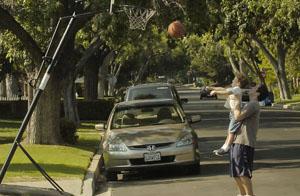
SHERMAN OAKS - A teenage boy and his 5-year-old neighbor shoot hoops on a quiet, tree-lined street.

It's a quintessential image of suburbia.

But it's illegal.

Now, a not-so-neighborly fracas has developed along Matilija Avenue after a former City Council field deputy reported that some households were violating two obscure city ordinances by placing basketball hoops above the curbs outside their homes.

The city served the offenders with notices to comply. Nate Brogin refused.

"This is a great opportunity for kids to come out after school and break a sweat. Isn't that what a quiet residential street is for?" said Brogin, 52, a longtime community activist.

"This is fascism from the city to say, You can't do this."

The relevant laws are almost older than the modern San Fernando Valley. One, included in the original municipal code enacted in 1936, restricts people from playing basketball, catch or anything else on city streets.

"No person shall play ball or any game of sport with a ball or football or throw, cast, shoot or discharge any stone, pellet, bullet, arrow or any other missile, in, over, across, along or upon any street or sidewalk or in any public park, except on those portions of said park set apart for such purposes," section 56.16 of the municipal code states.

The other ordinance prohibits any structures from being placed on a public right of way, such as sidewalks or the grassy paths that abut curbs.

Thousands of homes across Los Angeles block these rights of way with basketball hoops and landscaping.

Citing these properties typically is not a priority for inspectors more concerned with illegal dumping, said Gary Harris, chief investigator of street services for the Department of Public Works.

"It's something we rarely enforce," Harris said. "It's complaint-driven only."

The complaints on Matilija came from Candi Kovacevich, a former field deputy for Councilwoman Wendy Greuel.

"We have city ordinances for a reason," Kovacevich said. "What if a drunk driver was coming down the street?"

Two blocks from Brogin's home and on an adjacent street, her house has a long, flat, smooth driveway and a cemented workout area in the backyard with a weight bench and basketball hoop.

Kovacevich reported several homes with illegally located basketball hoops.

In retaliation, she said, someone went around noting other violations - such as vegetation obscuring a street sign in front of her house - and phoned them in.

She trimmed back the overgrowth. Her neighbors need to come into compliance too, she said.

Brogin's portable hoop sits atop a patch of grass between his driveway and his neighbor's.

This strip, dubbed a parkway, is city property.

The hoop overhangs a 6-foot stretch of curb, too short for parking, and is along the same line as the large Modesto ash trees that shade this street immediately north of the Fashion Square.

"It's the best thing he's ever done, putting it out there. The kids are out there every day using it," said Bruce Jacobson, a transportation supervisor who lives next door.

"I don't know what the problem is. The whole thing is stupid."

On a regular basis, neighborhood kids meet for games in the 5000 block of Matilija.

Brogin's 18-year-old son, Michael, has lost about 30 pounds since the hoop went up last year.

"In the Valley, the reason it is very hard for cars to get from A to B, unless they go on major streets, is precisely so kids can play in the street," said urban historian Joel Kotkin, who lives on a Valley Village street where neighborhood kids often play football.

"If you cited people for every little thing," he said, "you would have to occupy this place like Baghdad."

Jill Banks Barad, president of the neighborhood council, called the ordinances "draconian" and said the city should look into rolling them back.

Meantime, Brogin is preparing for an administrative hearing regarding his refusal to take the hoop down.

If no resolution is reached Tuesday morning in Room 420 of Van Nuys City Hall, Brogin's case will be forwarded to the City Attorney's Office for possible misdemeanor prosecution.

He could face up to six months in jail and up to a $1,000 fine.

"I don't care," Brogin said. "It is more important that my children and the children of the neighborhood have a place they can interact after school and get healthy exercise rather than being concerned about getting the strong arm of the city."

Monday, July 17, 2006

The Man Between

From: Los Angeles Daily News
www.dailynews.com

TARZANA - Jamal Haddad's story seems part Horatio Alger, part Larry Flynt.

The American dream of the Jordanian-born immigrant, who makes his living selling smut, has landed him in the cross hairs of the Los Angeles City Council.

City officials have tried for eight years to shut down the Frisky Kitty, the nude-dancing club he owns on Oxnard Street. Arguments for an injunction against the club will be heard today in Los Angeles Superior Court.

Haddad says the city's claims that he is violating zoning laws are baseless.

"We're not Mafia. It's just business. We're not doing anything illegal. We don't do drugs or prostitution or alcohol," Haddad said.

"We call it clean, fun entertainment."

Haddad and his family live in a two-bedroom apartment, two blocks from the Frisky Kitty, and he drives a Dodge Caravan.

He's currently trying to patent software that would pinpoint someone calling 911, even from remote locations. If that makes him a millionaire, he said, he'll unload the club.

But for now, he's happy selling skin - although about 7 percent of the club's revenue goes to legal problems that Haddad and a few Orange County investors inherited when they bought Dino's Victory Roadhouse in 2000 and renamed it.

The Frisky Kitty's hang-up is basic real estate: location, location, location.

Stripper clubs, which are prohibited from selling alcohol, cannot operate within 500 feet of many things, including residences. Within or beyond that distance - depending on how it's measured - are the Tarzana Courtyard Apartments, where a few dozen seniors live.

It might seem odd that in the San Fernando Valley - known to some as Porn Valley since it is home to most of the nation's pornography industry - a politician would care so much about a nude club.

But City Councilman Dennis Zine does, and the Frisky Kitty is in his district.

"If we can't prevail with existing zoning laws, all communities are in jeopardy," said Zine, a retired Los Angeles Police Department sergeant. "The laws are put on the books for a reason. Period.

"It's not moral or immoral. It's simply about the location."

On a recent day, Haddad drove past the Tarzana Courtyard Apartments and approached his club, where he is called "Big Papa," "Daddy" and "The Godfather." With short salt-and-pepper hair and crowded yellow teeth, he wore big Ray-Bans and a conservative gray suit.

The second son of a textile salesman, Haddad was born in 1960 in Al-Mafraq, Jordan. He moved to the United States after high school and enrolled in an English-language course in Orange County. He later went to trade school.

In the early 1990s, a friend who owned an Anaheim nude club called.

"I had a lot of free time, and my friend offered me a job, so I took it," Haddad said.

A few years later, he was visiting Jordan with his mother when he met Heyam Ayyoub. He promptly proposed. They wed in Las Vegas, and she joined him in Orange County.

Heyam Haddad, 33, never cared for her husband's work at the Anaheim strip club, so she wasn't pleased when he discussed taking ownership of Dino's Victory Roadhouse.

"I don't like his job," she said. "I'm a woman. I get jealous. You know?"

Heyam Haddad said she trusts her husband. But she takes their son and daughter to a Baptist church every Sunday, and she knows how Christians feel about places like the Frisky Kitty.

"She wants me to get out of the business," Jamal Haddad admitted recently, sitting against the club's stage. "So does my mom - and all my friends. Everybody is asking me to get out. It's a moral issue."

But Haddad sees it differently. "I care for the ladies, and I think it is one way to help them out," he said.

"He's the best," said Samantha "Kitty" Hasty, who has danced at the club for four years, longer than anyone else, and makes about $1,300 per week. "He'll help us out when we need it. He trusts us."

Mo, a club disc jockey who refused to give his last name because his Muslim family disapproves of his work, agreed. "You can ask him for a thousand bucks, and he says OK."

The club faced few problems when it operated as a bikini bar in the 1990s or even when it went topless in 1998. Later, however, the dancers went completely naked, requiring the club to give up its liquor license. Then city officials said the club is within 500 feet of the courtyard apartments, and the dancers were ordered to cover up - at least with pasties and G-strings. The club owner refused.

After city officials denied the request for an exemption, the club fired the first volley of the legal battle that went all the way to the U.S. Supreme Court, which declined to hear the case.

The Frisky Kitty purred quietly the past few years without a permit until the council ordered City Attorney Rocky Delgadillo to shut it down last winter.

"We can't selectively enforce. That leads to a slippery slope," said Frank Mateljan, a Delgadillo spokesman. "The defendants are not only ignoring the zoning laws; they are actually flaunting them, so to speak."

Judge Dzintra Janavs, who last denied a motion for a temporary restraining order against the club, will hear arguments on the injunction request.

Some neighbors, at least, don't seem concerned.

"Frisky Kitty don't bother me. It don't bother none of us," said Viola Houston, 73, who has lived at Tarzana Courtyard Apartments for seven years. "We don't hear nothing. Whatever they do, they do inside."

But the Tarzana Neighborhood Council hopes Janavs rules against the club.

"Those in the area believe prostitution is going on," said Leonard Shaffer, neighborhood council president.

That may have been the case in the past, said neighborhood prosecutor Mike Pizzuti, but complaints of illegal activity have decreased since Haddad met with police two years ago and hired private security.

Haddad's attorney, Roger Jon Diamond, has stated he can keep the city wrapped in litigation - like the $100 million defamation suit Haddad filed against Zine and the city in 2002 that was later dropped - for years to come.

Diamond's latest contention is unrelated to the First Amendment but to how the city measures the distance between a strip club and the nearest residence. It is clear with schools and churches, but there is some ambiguity regarding housing.

"If this were chess," said Haddad, a chess champion in his youth, "it's a stalemate, not a checkmate."

Tuesday, June 27, 2006

"You called me with jack high!?!"


From: Los Angeles Daily News
www.dailynews.com

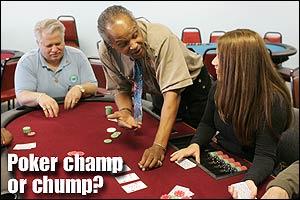
Five card players sit around a Reseda poker table while the dealer takes lessons from a homeless man.

"Make sure you lay the card flat. You gotta lay it flat, otherwise everyone can see," the man tells an aspiring actress who paid $750 for six weeks of dealer training.

The instructor wears unstrapped black overalls, leather sandals and socks, an olive green shirt and a tie-dyed tie. He is Ellix Powers, former crack addict, recovering vagrant and professional poker player - a competitor in the World Series of Poker that starts in Las Vegas today.

From beneath the Ventura Freeway, Powers burst onto the poker stage in 2004, winning two tournaments at the Bicycle Casino in Bell Gardens before becoming one of the most memorable characters at gambling's biggest tournament.

Since then, he's been living in Reseda or Arleta or Long Beach - pretty much anywhere there's a friendly couch - while he waits for his investments to pay off. He's starring in an unfinished independent documentary about the hard life of poker players and teaching at the Poker Academy on Sherman Way.

Powers, 53, is too busy with teaching to spend as much time gambling but he didn't want to miss the World Series. The first of 45 events begins today; the no-limit hold 'em world championship will run from July 28 to Aug. 10.

In the past few years, poker has become a national phenomenon, a roll of the dice that gives more skilled players an edge but offers a rush that some pros describe as better than sex.

At the 2003 World Series, an unknown Nashville, Tenn., accountant - aptly named Chris Moneymaker - won the main event and $2.5 million. Moneymaker beat a field of 839. Last year, the $7.5 million champion had to outlast 5,618.

"The Moneymaker effect has sent a very clear signal that just about anyone can win our tournament," said World Series Commissioner Jeffrey Pollack. "It's pretty unique that the housewife from Peoria can pay to enter and end up sitting at a table with one of the top players in the world."

Moneymaker made a lot of people believe novices had a chance in any poker game, something that couldn't be said about rookies at the Boston Marathon, the Master's or Wimbledon.

So some have shifted from the suit-and-tie life to hustling online poker games and card rooms. But the specter of riches remains an illusion for many more.

"It's no different than playing in the NBA. There are hundreds of thousands, if not millions, of kids who think they are going to make it to the NBA. But there are only 400 players in the NBA," said Pollack, a former National Basketball Association executive. "The odds of making a living competing at the absolute highest level are very, very slim."

Powers knows that.

In 2004, he incited the World Series' second-most memorable moment, his 15 minutes of fame replayed over and over on ESPN reruns.

At the final table for limit hold 'em, Powers did everything he could to disrupt the game's natural flow.

He bet and raised before being dealt cards. He offered patronizing apologies for his capricious play. He thanked opponents for losing while they were still in the hand. He flat out talked trash like former Laker Gary Payton.

"You're disrespecting the game," author James McManus scolded him.

"I can raise in the dark anytime I want," Powers shot back, referring to his move of betting without looking at his cards. "I'm going to do it every time now."

His erratic play got the best of McManus, who quickly called a bet from Powers when all McManus had was queen high. Powers taunted him, albeit inaccurately.

"You called me with a jack high? You called me with a jack high? He called me with a jack high," Powers repeated after goading McManus into the bad play.

"This guy is nuts. I like him. He's good for poker," pro John Hennigan mused. "I'm having fun. I never have fun. This guy is making me have fun."

Powers eventually got bumped in seventh place and strutted to the cashier.

"Do I get any money here? Do I get any money?"

He got $40,040. But Powers has only won about $12,000 at tournaments during the two years since, according to a database of pros at pokerpages.com. He's also won and lost an unspecified amount playing in casinos and mostly online.

"Poker is a big, cruel beast," Powers said in an interview. "There's not a lot of sympathy in the game. There ain't no refunds."

As he sat down for lunch at La Tortilla Loca in Reseda, he asked a reporter who was buying.

"I don't eat that much," he said, adding that he usually doesn't order food and just waits for friends' scraps.

The waitress approached.

"What kind of beer you got?" Powers asked her.

Interrupted and told free beer wasn't part of the deal, he ordered water.

"I was born in the service," Powers said as he began to unfold his history.

His father, Elliott, was an Air Force colonel, and Ellix grew up in a strict house.

"There's nothing I know about him," Elliott Powers, now an attorney in Colorado Springs, Colo., said of his son. "He didn't get a college degree; he's living under a bridge. He's been very disappointing."

The family moved a lot. After graduating from high school in Sacramento, Powers left for college in Kansas, where he met a woman.

She left for Utah, he followed. They had a daughter and parted ways.

Powers ended up in Reno and found cocaine before escaping to Kansas City, Mo. There, he met another woman. After they married and had a daughter, they quickly divorced, and Powers set out for California.

Los Angeles offered another clean slate, but the casinos south of downtown and the crack cocaine flourishing in that area in the early 1990s were too strong a pull.

"I was dabbling with the devil," he said.

Then, one day three years ago, Powers had an epiphany in between panhandling under Highway 101. He had been reading "More Than a Carpenter," a book by Christian author Josh McDowell, and Powers decided he needed to dedicate his life to Jesus Christ.

"I used to always pray, hope God would get me out of this mess," he said. "Eventually, he caught up with me."

Shortly after, in March 2004, Powers won two tournaments at the Bicycle Casino and pocketed $46,535. After the World Series, he returned to L.A. and tried grinding out a living at area card rooms.

A year ago at Hollywood Park he met Stuart Locascio, a Panorama City jeweler with hopes of opening a poker school in the San Fernando Valley.

Locascio believed there was a market for training dealers, servicing parties and providing a place for novices to practice. Poker Academy opened in December with Powers as its poker education director.

The academy opens at 11 a.m. daily and closes when Locascio or Powers decides no more clients are coming, usually after 8 p.m.

His duties haven't left Powers much time to visit casinos. Plus, he needs a lift to get there because his '98 Pontiac Firebird is parked in Reno, Nev., home of the Peppermill Hotel Casino, which Powers considers his permanent residence.

Lacking much time in casinos, Powers hasn't been able to find a financial backer. These venture capitalists, if you will, offer a trade-off: Play for free, but return some, often half, of the winnings. They are the lifeblood of many high rollers.

But Powers said he garnered enough to enter four or five World Series events at the Rio All Suite Hotel and Casino, including $10,000 for the main event. He also plans to hang around the casino and look for suckers throwing money away in nontournament games.

Ed Moulton first met Powers at one of those tables during the World Series last year.

They got to talking, and Powers quickly asked Moulton for $200 so he could enter a satellite tournament, which, if he won, would pay his entry into a bigger event. Moulton agreed.

Powers called the next day. "Oh man, I'm so depressed. Things didn't go my way," Moulton remembered hearing.

Later, though, Moulton ran into a mutual friend who said Powers didn't even enter the tournament.

"This guy was like, `Watch out for Ellix. He's a street hustler,"' he recalled. "That only made me want to hang out with Ellix more. When his stay was up at the Little Hotel, he crashed with me for a few days."

While Powers' life story is unique, his financial struggles are not.

Gamblers are notorious for their "leaks" - extracurriculars that siphon away a chunk of their winnings. Some of poker's biggest stars win hundreds of thousands of dollars in tournaments, and then lose it playing craps or betting on sports.

Without question, poker favors the more skilled, and, many would argue, the more patient. It is a game of information. The more rationally players evaluate their cards against what their opponents might have based on betting patterns, the more they'll win.

Still, poker is gambling and it attracts people who enjoy taking risks, said David G. Schwartz, director of the Center for Gaming Research at the University of Nevada, Las Vegas.

"Nick the Greek was the biggest gambler in the history of the 20th century," Schwartz said. "He ended up playing dollar games down in L.A., and when he died, they had to take up a collection for his funeral."

Powers' leaks were always drugs. But now he's sober and has a regular job. He doesn't have a place of his own but at least he has friends who do. And he's living with more stability than he's known in 20 years.

Yet like an entertainer remembered as a one-hit wonder, he is desperately looking to move beyond his "jack-high" fame.

"You can have one record or you can do one movie and you can be OK for a while, but until you follow through, you really ain't made it yet. But that's where I'm at, and I'm working on it," he said. "I don't want to own everything. I just want to be in charge of my life."

Friday, June 23, 2006

"These men aren't drunk, it's only 9 in the morning ..."

From: Los Angeles Daily News
www.dailynews.com

STUDIO CITY - Early morning on a workday seems an odd time for a bunch of Yankees to be watching soccer in a British pub.

But that was the case Thursday at The Fox and Hounds, where about 100 Angelenos arrived before - or instead of - work to watch the U.S. soccer team take on Ghana in a World Cup must-win match for both. It was a reminder that futbol may not be football in the United States, but for at least one month every four years, it attracts a crowd.

"I could watch it at home, but you don't get the shared excitement and the shared pain," said Tommy Mack, 36, of Toluca Lake. "Besides, I don't have Guinness on tap."

The Fox and Hounds and the White Harte pub in Woodland Hills, with the same owner, have been busy in the first round of the World Cup, opening the doors at 5:30 a.m.

When the U.S.-Ghana game started and ESPN broke away to a live shot of fans watching in New York's Times Square, the crowd there was smaller than that inside the Studio City pub.

"Futbol doesn't exist here, and yet you go to places like this and it does, but it's sort of a hush-hush, under-the-table existence," said owner Gary Richards, who made about $2,000 in sales during the morning game.

Many of the early-morning patrons showed up in sports coat and ties, en route to the office. Others had phoned in sick and wore soccer jackets and jerseys.

"I took the day off because I will either: a) be so ecstatic that I keep drinking until I pass out, or b) be in such a funk that I would hit people with my fist," Mack said.

The funk began in the 22nd minute, when Ghana took the lead after stripping the ball from U.S. captain Claudia Reyna. He fell down, holding an ankle, as players like to do after they get beat.

There was much booing in the pub.

"Reyna should have retired after that goal. He's too old," said Dave Zierler, 31, of Santa Monica, watching the game before heading to work at Universal Music.

Zierler and many others wondered just where the U.S. team's underrated opponents came from. "Ghana? I think it's somewhere in Africa. I don't think anyone knows where it is," Zierler said.

Ghana - whose team was ranked 48th by FIFA before it shocked the second-ranked Czech Republic on Saturday - is in western Africa, between Ivory Coast and Togo. This is Ghana's first World Cup competition.

At 7:43 a.m., seven minutes before halftime, U.S. midfielder Clinton Dempsey volleyed a point-blank bullet into the left corner, and the pub erupted.

To advance, the United States needed Italy to beat the Czech Republic in a game being played simultaneously. Bar TVs showed Italy up 1-0. Americans were starting to believe.

But three minutes later, hope was fleeting.

"Ooooooooohhhhhhhhhhh!"

"That's a horrible call!"

U.S. defender Oguchi Onyewu had just jumped into the air for a head-ball, barely making contact with a Ghana forward. But the referee blew his whistle and awarded the Africans a penalty kick. The result: 2-1, Ghana.

"It is astonishing that, at this height of the game, the officiating is so disastrous," Dan Loney said.

The second half began slowly. Emotion at the bar was muted. "This is ridiculous; I can't stand watching this. They are flat-footed," said Jason Cook, a "Days of Our Lives" actor and midfielder for the Conejo Valley United Soccer Club.

But then the United States turned up the pressure. There were rolling roars of excitement between the 65th and 68th minutes, when the U.S. had three promising shots on goal.

That was as close as the U.S. team got. At 8:50 a.m., with five minutes left and work fast approaching for many, people started slipping out. "Bottom line: We blew it," Mack said.

After the ref sounded the final whistle, Moses Atangana busted open the bar door - his world going from dark to bright - and offered some unexpected jubilation.

"We did it! We won!" said Atangana, a Ghana fan who said he long ago played for the national soccer team of his native Cameroon.

Inside the pub, Eddie Francoeur, 31, of North Hollywood sat at the bar, mourning with friends and his fourth pint of Carlsberg beer.

Francouer skipped work Thursday after calling in sick - which he truly may have been after the U.S. loss.

"I'm going to be here until they kick me out tonight," he said. "I'm going to drink heavily until we qualify for the next World Cup."

Monday, June 12, 2006

"Condo-mania"

From: Los Angeles Daily News
www.dailynews.com

STUDIO CITY - Jane Drucker moved into a 1948 vintage apartment on Laurelwood Drive 21 years ago. A block south of Ventura Boulevard, the street had all the charm she needed.

But little by little, Drucker has watched that fade. In the past two years, two homes and a piece of land on her side of the street have morphed into luxury condominiums.

Drucker's building is slated to be next.

"You're losing the social structure of the neighborhood," the 54-year-old life coach said, sitting in her spacious yet cozy two-bedroom apartment at 11805 Laurelwood. "And we can't afford to get into the condo market. Somebody suggested we use our relocation money as a down payment. Well, $3,000 is going to get me a car but not a condo."

The disappearance of rent-controlled apartments - those built before 1979 - is a phenomenon occurring across Los Angeles. More than 11,000 such units have vanished during the past five years, including about 7,000 in the past 18 months.

In Van Nuys and Encino, Sherman Oaks and Sun Valley - from the northern San Fernando Valley to the South Bay - developers are making a tidy profit converting these units or completely rebuilding them as condos and town homes.

"This wave of condo-mania is ripping through the heart and soul of many...L.A. communities, and it's just running like wildfire," said Larry Gross, executive director of the Coalition for Economic Survival, which led the rent-control movement in the late '70s and is pushing for a moratorium on condo conversions.

A changing cityscape is visible across Studio City - in scores of under-construction monoliths along the L.A. River, on Coldwater Canyon Avenue, near the CBS Studio Center. On Moorpark Street before 8 a.m. recently, a bulldozer turned to rubble a cottage home standing the night before, clearing ground for eight condos.

Low-rent tenants are being evicted and can't afford apartments at the market rate. Those who remain are frustrated by the fleeting charm of their once homey neighborhoods. The issue is acute in the 11800 block of Laurelwood Drive.

"I went to sleep and woke up and found myself surrounded by condos that literally went up overnight," said Keith Merritt, 38, a writer who lives in the Laurelwood Penthouse Apartments.

The 20-unit Rudolph Schindler building, one of Studio City's few cultural landmarks, is listed for sale at $5.9 million. The owner is trying to convince interested buyers it could be converted into condos without much fuss. Because of the historic designation, it would be cumbersome, though possible, to raze the building.

Laurelwood already has been overrun with traffic, construction crews and illegal parking, residents say. Carpenter Avenue School is beyond capacity. And $900,000 condos will usher in anti-family yuppies who won't care about their neighbors, critics say.

To be sure, parking is atrocious during the day, but restricted to residents from 10 p.m. to 6 a.m. Carpenter's principal said the school has 848 students and can handle 900. And, of course, it's natural to resent a neighbor whose purchase might motivate your landlord to evict you and build condos.

Public meetings

Furor and fear have resulted in three joint meetings of the City Council's planning and housing committees. A standing-room-only crowd of about 400 people packed Monarch Hall at Valley College recently to address concerns about Studio City and Valley Village.

But solutions aren't simple. Under the state Ellis Act, landlords cannot be forced to stay in the apartment business.

"They can tear down their building. There is nothing I can do about that," Councilwoman Wendy Greuel said. A Studio City resident, Greuel said the community needs a balanced housing stock, but didn't elaborate.

The Department of City Planning could not provide statistics on new condo construction and conversions under way in individual communities because those figures are kept only by council district.

But in Studio City, where the median-priced home hit $875,000 in April, the most recent period reported, and where condos seemingly sprout in larger numbers than anywhere else in the Valley, rent-controlled units are, as Valerie Yaros says, "endangered."

"The whole character of the neighborhood is being destroyed. And the color is changing from green to beige. I call this condo-mania `the beige plague,"' said Yaros, who has lived in the Twin Palms apartments on Laurelwood since 1990 and pays less than $1,000 for a two-bedroom.

"Look at what's in front of my building. Look at all the green! Trees. Palms. Flowers," Yaros said as she walked Laurelwood. "Instead of preserving, they just see massive, massive profits. Going. Going. Gone!"

The Twin Palms' owners, who declined to comment, sent tenants a letter in April that said they were "exploring the feasibility of demolishing the building and putting the property to some other use."

This has become a common tactic: Instead of dealing with the complications of converting apartments to condos, developers are scrapping whole complexes and starting over.

When a $1 million home can be replaced with four condos that will sell for $800,000 each, the incentive to build condos is clear. Same goes for trading 20 apartments - which could generate a combined $30,000 a month and require upkeep - for 20 condos.

But, similar to the period before real estate tanked in the early 1990s, a glut of unreserved, under-construction condos is developing.

Deck House Court, built on a vacant Laurelwood lot between Drucker's and Yaros' apartments, was completed in January but has only filled 11 of 21 units, ranging in price from $695,000 to $900,000.

"Everybody is used to the fast market, and now it is slowing down," said Joanne Lindsay, an agent selling the town homes. "It's not that there is anything wrong with it. It's nice for the buyers to have a chance to breathe."

If the real estate market continues to slow, the motivation for apartment owners to convert their units to condos will dissipate, said Chris Thornberg, an economist with the UCLA Anderson School of Management.

"This will pass. We will get through this," said Thornberg, who long ago theorized the current housing market is a bubble set to burst.

However, Thornberg said any additional regulations, such as a moratorium on building condos, would discourage developers from buying a piece of land for new apartments and would worsen rental conditions.

Cashing in

Meanwhile, apartment owners are still trying to cash in. Laurelwood Ventures, which purchased Drucker's building less than two years ago, applied last July to build 24 condos in place of 15 apartments.

"Obviously, the motivation is financial," said Ben Reznik, the developer's attorney, who added that the condos would have 54 parking spaces and would improve the street.

"Maintaining older buildings like this and just keeping them there - some people view these as more affordable than what would be built - is a sort of naive and backwards way to think of maintaining a stock of affordable housing because the owner is disincentivized from putting money back into the building," Reznik said.

The condo project was approved in March and appealed by the Studio City Residents Association, which disagreed with the city's willingness to vacate 30 feet of Laurelwood to the developer. The South Valley Planning Commision rejected that appeal Thursday, and the residents association is considering appealing to the City Council.

Development guidelines are laid out in the city's general plan for Cahuenga Pass, Sherman Oaks, Studio City and Toluca Lake. It hasn't been updated since 1987, so residents are fighting building proposals as they arise.

"We usually reach agreement on these things," said Tony Lucente, president of the residents association. "But in the last year, the scales have been tipped, and people are very angry and upset because they are literally witnessing the destruction of our neighborhoods.

"The thing I always say to developers is, You're dying to come into Studio City because we've made it such a good place. But how long will that last?"

Paralee King, 59, has lived on Laurelwood since she was 7. Her house is one of only two remaining on the north side of the block. Last February, she bought the other, paying about $850,000 for the 1,300-square-foot, 1939 cottage. She's since made about $200,000 in upgrades.

The purchase made her a hero among some neighbors. But King wants no such esteem.

"I wanted that house because I don't want a high-rise next to me," King said. "But if I want a high-rise, that's my decision. I don't need any neighborhood association telling me what to do.

"I'm sorry about all the building, but they should have stopped it 10 years ago when that building went up across the street from me. It is too late now. They want to stop it from happening to the last two houses on the street?" she asked. "It's too late."

Friday, May 19, 2006

Opus Dei a Block Away


(St. Josemaria Escriva, founder of Opus Dei)

From: Los Angeles Daily News
www.dailynews.com

Without entering the priesthood, George Cassar wanted to commit his life to the work of God.

So he pledged himself to a life of celibacy, giving God every dollar beyond what he needed and turning his job into a 40-hour-a-week prayer.

"The key is trying to do the work well, do it with human perfection as Christ would do it," the Raytheon engineer said.

Cassar, a 20-year-member of Opus Dei who lives at its Tilden Study Center in Westwood, is a stark contrast to the murderous albino Silas from Dan Brown's "The Da Vinci Code."

With a film based on the book and starring Tom Hanks opening in theaters worldwide today, the Catholic Church's most controversial organization is bracing for renewed scrutiny.

Opus Dei -- literally translated in Latin as "the work of God" -- has been shrouded in mystery since its founding in 1928 by a charismatic Spanish priest named Josemaria Escriva. The group, which has about 87,000 global members, including 3,000 in the United States and 180 in Southern California, has been accused of intense recruiting, brainwashing and political puppeteering.

"Think of it as the Guinness Extra Stout of the Catholic Church. It's a strong brew, definitely an acquired taste, and clearly not for everyone," John L. Allen Jr. wrote in the introduction of his book, "Opus Dei," published last fall to dispel the myths of Brown's book.

Allen, a Vatican correspondent for the National Catholic Reporter, dedicates his book to answering the many criticisms of Opus Dei, which he argues have little merit and, in part, stem from a fear of change within the church.

"The Da Vinci Code," which Brown billed as based on previously unearthed history, claims Opus Dei exists to protect a 2,000-year-old church cover-up -- that Jesus Christ married Mary Magdalene, and that their descendents are alive today.

"I got in about 20 pages, and I couldn't read anymore. It was silly. I think it's a piece of crap," said the Rev. Paul Donlan, a Harvard-educated priest at Tilden.

Donlan, a pale man with snow-white hair, has a comical -- if a bit uncomfortable -- bond with the character Silas.

"Everybody pulls my leg, ‘Oh, you're the albino,' " Donlan joked. "The nearest I got to being an assassin was when I was a chaplain in the Marine Corps."

The core of Opus Dei servicemen, however, are not the priests but the laity, the doctors, accountants, teachers and engineers who hone their heart on serving God through sanctifying their work.

Paul Ybarra, a Los Angeles city fire captain, said he had grown tired of Sunday Christians -- those Catholics who serve God at Mass but not during the week. Then he stumbled upon Opus Dei.

"They threw down the gantlet to be a saint," said the 45-year-old Valencia father of four.

Ybarra said he learned to serve God by dedicating his firefighting to him and not himself.

"Our work is our prayer," he said.

That concept also attracted Dennis Dubro, who joined in Boston as an M.I.T. student in 1969.

Seventeen years later, though, Dubro left Opus Dei embittered by what he claimed were "extremely aggressive" and "deceitful" recruitment strategies. He also said members learned to do whatever a higher-ranking official told them but to act as if it were their choice.

"That's a whole element of the brainwashing thing: You never admit you're brainwashed," said Dubro, a 55-year-old Bay Area engineer who remains a devout Catholic.

Much speculation has been made about Opus Dei's role in the Catholic Church and its influence in global politics. Many members choose to remain anonymous because of the undesired scrutiny of claiming membership.

It is the church's only Personal Prelature, which means local officials aren't accountable to the Archdiocese of Los Angeles but to an official in Rome who reports to the pope.

Known as numeraries, about 20 percent of Opus Dei's members are celibate and single. Supernumeraries, comprising about 70 percent of members, are married and live with their families. They give to Opus Dei all income over household expenses.

The organization has worldwide assets of about $2.8 billion and of $350 million in the United States, according to Allen's book. That's only a fraction of the 2001 revenue of all U.S. Catholic programs: $102 billion.

Among Opus Dei's worldwide holdings are 15 universities, seven hospitals, 11 business schools and 36 elementary and high schools, with ambiguous names like Northridge Prep in Chicago.

They operate Tilden and 59 other study centers in 19 American cities. Most are located near prestigious universities, where Opus Dei can find young, bright minds.

Cassar was introduced to Opus Dei while attending Loyola Marymount University in the early 1980s. The group had a house in Cheviot Hills at the time, and one of Cassar's classmates invited him to visit.

"I checked them out, and it was feeding my soul," he said.

He joined in 1986 and that year helped open the Tilden Study Center, where he has lived since.

Every weekday morning, Cassar rises at 5:25. He prays for 30 minutes, attends Mass in Tilden's small chapel and shares breakfast with the eight other men who live there.

Cassar says the rosary as he sits in traffic driving from Westwood to El Segundo for work. On his desk at Raytheon are images of the Virgin Mary and St. Josemaria Escriva, whom Opus Dei members refer to as "the founder." Cassar tries to open and close doors in a way that won't disturb others.

And throughout the day he repeats mnemonic prayers, such as "He must become more" when he climbs stairs and "I must become less" when he descends them, as simple reminders to himself that his life's purpose is to serve Jesus.

"It's like an Internet connection. Maybe you had a flaky connection, the cord in the back of your computer wasn't fully plugged in. But once you get it plugged in, it shoots out all this information," Cassar said. "It's as if my eyes are not my eyes, my nose is not my nose, my ears are not my ears. They are all Christ's because I am fully connected.

"It is basically like being in the spiritual zone."

Thursday, May 18, 2006

Praying for a Gas Drop


From: Los Angeles Daily News
www.dailynews.com

The Rev. Beatrice Williams drove 110 miles to Hollywood on Wednesday to beg the Lord for lower gasoline prices.

"There is victory when we stand together," Williams said, after joining eight others in prayer. "We will overcome, and we will overcome this if there are enough people who believe that God cares."

Standing beneath the Gothic Revival tower of Hollywood United Methodist Church - and across from a Chevron station charging $3.43 a gallon for unleaded - the group asked God to comfort those paying more while driving less.

"We give you praise and honor and glory. You are king of all kings. You know our needs," Bishop Donald Downing, pastor of Heart to Heart Christian Center in Fort Washington, Md., prayed as cars zipped through the intersection of Highland and Franklin avenues, occasionally honking.

"These high gas prices, Lord, bring them down, oh Father."

These prayer warriors were hoping to induce the same miracle the effort's organizer, Pray Live, claims it brought about in Washington, D.C. After about 50 attended a gathering in late April, national fuel prices dropped a few cents.

Californians, however, continue to see prices sky high. A gallon of regular averaged $3.39 in Los Angeles on Wednesday - down, but just a penny from Tuesday.

"This will be a testament to all of the people who don't believe in the power of prayer," said Wenda Royster, director of Pray Live, which operates a 24-hour phone and Internet prayer line.

"Gas is almost like water, especially here in California, where people drive far to work and can't rely on public transportation."

Gasoline experts have been offering advice for months on how drivers can reduce fuel prices: empty the trunk, combine errands, keep tires properly inflated, maintain a steady speed.

"People seek - what is the word I'm looking for? - relief in many ways," said Jeff Spring, a spokesman for the Automobile Club of Southern California. "We would recommend they continue to try to cut their use of gas to try to lower the prices. Reduced demand will lower their prices."

What about asking for help from above?

"I'll leave that question up to the theologians," Spring said.

In Scripture, God's children tend to pray for illnesses to be healed and for persecution to be stopped, said Patrick Miller, professor emeritus at Princeton Theological Seminary.

"Situations that evoke people's crying out to the Lord - what I would call prayers for help - tend to be situations when the community is in dire straits," Miller said.

But rising gas prices are different because it's possible God is reminding Americans the world has limited natural resources, Miller said. Praying to overcome human excess would be like praying to ace an exam that wasn't studied for.

On the other hand, it would be appropriate to pray for wisdom to respectfully live in God's creation and conserve natural resources, Miller said, which was why the Rev. Ed Hansen agreed to have Wednesday's prayer session outside his church.

"It is very unjust that profits can be so high when people are so deeply affected," said Hansen, who drives a 2004 Prius and lives a mile from his church. "From a faith perspective, I believe God wants us to work for justice."

While Hansen said some people at United Methodist are struggling to pay rent or put food on the table because they're paying steeper prices for gas, ExxonMobil, the world's largest publicly traded oil company, reported a record profit of $8.4 billion in the first quarter of this year.

The national average for a gallon of gas rose again this week, closing at $2.93 on Wednesday.

The prayer group didn't expect God's answer to "come down in a lightning bolt" but to lower prices over time by guiding politicians on energy policies.

Not everyone was a believer, though. Holding signs calling people to prayer, the group was unable to lure any passers-by into its fold.

"Pray for lower gas prices?" a twenty-something man said, cocking his head as if confounded by a great riddle. "I'll think about it," he said, deadpan, and hurried off.

Friday, May 12, 2006

This one is uplifting

From: Los Angeles Daily News
www.dailynews.com

Sergie Mendoza makes $60,000 a year customizing cars at a Canoga Park garage - an income that in most places would afford him a middle-class lifestyle.

Instead, Mendoza plans to move his wife and two children to a place where the American dream costs a lot less.

"We're going to move out of here. We're going to Florida," said Mendoza, 34, who's already sold his Northridge home. "It's too hard to live here. Everything is too expensive. You can't survive."

Californians such as Mendoza are increasingly finding it harder to make ends meet, according to a Public Policy Institute of California report to be released today.

The study is also critical of the criteria for the federal poverty line, which is based on income and doesn't take into account the cost of living in a specific region.

After adjusting for home prices, the percentage of Los Angeles County residents living below the poverty line increased from 15 percent to 18 percent, placing it among the 10 highest-poverty counties in the nation, the study found.

California's ranking among the states and Washington, D.C., rose from 15th to third.

"We don't have a realistic picture of how many families are struggling to make ends meet in California, which is particularly true in Los Angeles," said Deborah Reed, the study's author and director of the institute's population program.

The study also attributed California's hidden poverty to the nation's largest immigrant population and to growing income inequality.

Incomes have fallen 4 percent for low-income families since 1969, while rising 16 percent for middle-class and 41 percent for upper-class families.

And what is average costs a lot more. In the past year, for instance, San Fernando Valley home prices soared 17 percent and apartment rents 9 percent.

In addition, the Los Angeles Department of Water and Power has proposed raising water rates 3.9 percent this year and 3.5 percent next.

Mayor Antonio Villaraigosa is pushing a 64 percent trash-fee hike.

And nobody needs to be told that gas prices - among the highest in the nation - are through the roof. The local average for unleaded is now $3.39.

"There are millions of people in L.A. County who are not affording the basic necessities to support their families. It's obvious in the crisis we are seeing in housing and education and, of course, health care," said Jessica Goodheart, co-director of research at the Los Angeles Alliance for a New Economy.

The federal government's formula for calculating the poverty line - devised four decades ago by the Office of Management and Budget and used by the Census Bureau - is adjusted for inflation but doesn't account for disparities in costs for utilities and real estate markets.

The poverty threshold for a family of four was $19,157 in 2004, the most recent year statistics were available. That year, landlords could charge low-income tenants $12,252 in Los Angeles, which experts say doesn't go far in booming Southern California.

"Right there, if you are paying the fair-market rent, 64 percent of your income would go into that rent," Reed said.

Needy Californians also are less able to qualify for anti-poverty programs, such as food stamps and Head Start, because their income is more than 80 percent above the poverty line.

For example, almost 2 million Californians participated in the federal Food Stamp Program last year, second only to Texas. But in New York, with a population little more than half of California's 38 million, 1.75 million people received food stamps.

In Louisiana, which has a lower poverty ranking when adjusting for housing costs, 18 percent of the state got food stamps in 2005.

Today's report is the latest to criticize the federal poverty line. In 1995, the National Academy of Sciences recommended that the poverty-threshold formula take into account food, clothing, health care, housing and utilities.

"The saddest part to me is watching the young people have to work full time, go to school and every penny they make is going to cover their rent - nothing more," said Toni Gorton, a Woodland Hills psychotherapist.

"I think we can kiss the middle class goodbye."

Thursday, May 11, 2006

The House We All Grew Up In ...


From: Los Angeles Daily News
www.dailynews.com

The archetype of San Fernando Valley architecture is a small house with a peach wooden-panel exterior, tall windows and that classic ranch look.

Like much of the Valley, Violet McCallister's Studio City home was built in the 1950s. It looks nondescript, even plain, but it still draws an international audience.

"There isn't a day goes by that there isn't a looky-loo or someone taking pictures," said McCallister, who with her husband bought the home in 1972, during the fourth season of "The Brady Bunch."

"Last week, 7 o'clock at night, some girl knocked on the door. Is this the Brady Bunch house?'"

"Yes," McCallister answered.

"Oh good. I'm from Arkansas. I've been looking all day for this house," the girl responded. "Do you mind if I take a picture?"

Few, if any, San Fernando Valley homes can claim such fame. But just as Gutenberg is known for the Bible and Edison for the lightbulb, the Valley is known for its collection of tract homes.

"The incentive to create mass suburbs," said urban historian Joel Kotkin, "was greater here and happened faster than elsewhere. When other suburbs began to grow at the same rate, they followed the model that the Valley did."

That can be seen in Long Island, N.Y., which bloomed with new communities a decade behind the Valley; outside Atlanta, which is now one of the fastest growing areas in the country; and in Sun Belt cities like Las Vegas and Phoenix.

In the Valley's first town, there were Craftsmans and Queen Annes, Spanish Colonials and Mission Revivals. Built along the Southern Pacific Railroad in the late 1800s, the city of San Fernando has homes more common to urban L.A. than the suburbs.

Valley development followed in patches, with communities like Van Nuys and Tujunga and Woodland Hills separated by vast farmlands and citrus groves. Those gaps were filled in the late 1940s and '50s as thousands of World War II GIs looked for pleasant neighborhoods to start their families, and Valley construction took off.

"Because of the federal-housing guarantee and the loans available to veterans, the dream of owning your own home became a reality," said Kenneth Breisch, director of the University of Southern California's Architectural Preservation Program.

The 1,000-acre Panorama Ranch was the site of the Valley's first master-planned community. Made to order with schools, a hospital and industry, Panorama City was a forbearer of the low-slung, tract homes that would epitomize new developments across the semiarid floor. A $500 down payment could secure a two-bedroom home on a tree-lined street.

The community's success would earn one of its creators, Fritz B. Burns, the designation of "Mr. Housing, U.S.A.," according to James Thomas Keane's biography of the L.A. developer.

For others involved in the home-building process, the Valley was a canvas with plenty of room for them to leave their mark.

Edward H. Fickett, an architect whose signature is on thousands of homes like those in Meadowlark Park and Sherman Park in Van Nuys, is remembered for drafting blueprints with the passion of an artist and the pragmatism of Henry Ford.

"He isn't remembered as an architect for designing one particular house," said Chris Hetzel, editor of preservela.com. "He is remembered for defining housing as we know it."

Fickett convinced developers that people would spend more for a house that looked less cookie-cut.

"I call it Modernism for the Masses," said Ken Bernstein, director of preservation for the Los Angeles Conservancy.

Fickett plans were a riff on ranch houses. They had grown popular in the run-up to war thanks to cowboy-actors like Roy Rogers, who lived on a Chatsworth ranch. That style would go mainstream with the housing boom, when land seemed more limitless than air.

"The ranch house was quintessentially anti-urban," Breisch said.

Many houses were built with floor-to-ceiling glass. Floor plans were open and utilized the Southern California climate. They had a backyard and, for the fortunate, the iconic swimming pool.

"That, is traditionally suburbia," said Sherwood Schwartz, who in 1969 chose the Valley for the setting of his television show, "The Brady Bunch."

The irony is that the Brady house was not quite as it appeared. It was difficult enough for six kids to share one bathroom; imagine that in a one-story, two-bedroom house. So Schwartz had a faux window added to the wall above the garage to give the curb-appearance of a second floor. The show was filmed on a Burbank set.

The house — myths aside — came to embody the ideal of a quaint suburban life, of a place where a lovely lady and a man named Brady could raise a happy, if utopic, blended family.

Added Schwartz: "That was the Valley in those years."

Sunday, April 30, 2006

Where's the Weed? -- Everywhere.


From: Los Angeles Daily News
www.dailynews.com

The plainly labeled brown door on the second floor of a Studio City office gives no indication of the marijuana being sold inside.

Valley Collective Care keeps the deadbolt locked. Inside sits an armed security guard; another watches over the stock. There is a surveillance TV in the lobby, a few copies of Amsterdam News and a white poster board with the handwritten message of the Fourth Amendment, protection from warrantless searches.

Between 11 a.m. and 7 p.m. daily, patients walk in with a slip of paper and an ID, and a few minutes later leave with a cure for what ails them.

Valley Collective was one of the first medical marijuana dispensaries in the San Fernando Valley when it opened last August. Now there are at least 20 in the Valley, with about 50 operating countywide and more than 200 throughout the state.

"This is the wild, wild West. Everybody is just trying to stake their claim," said Scott H. Linden, a Pasadena attorney who has helped several Valley dispensaries open.

Ten years after voters approved Proposition 215, legalizing marijuana for medicinal purposes, these pharmacies operate with little oversight.

Advocates maintain fairly comprehensive databases, but government officials, including those of the Los Angeles Police Department and the county's public health chief, don't even know how many dispensaries exist.

All it takes to get started are a few easily obtained business licenses, a willing landlord and a list of doctor-recommended patients such as Fritz Weaver, 44, of North Hollywood.

"I can function on pot and it doesn't destroy my liver," said Weaver, whose doctor told him to find an alternative to Vicodin for chronic back pain. "It's a no-brainer."

Cannabis clubs, or co-operatives, have been the source of controversy. Patients like Weaver have come to rely on them for comfort, but communities have taken a decidedly different view.

Because they house massive amounts of cash and thousands of dollars worth of marijuana, dispensaries have been targeted for smash-and-grab burglaries; Valley Collective had computers and an undisclosed amount of cash taken March 29. Some co-ops also have been accused of selling to people without prescriptions.

Seeking to limit such problems, some Northern California communities - including San Francisco and Oakland - have moved to regulate where, when and how these clinics operate.

Pasadena and 19 other cities have outright banned them.

And nearly 60 cities - including Simi Valley, Moorpark, Long Beach and West Hollywood, which already had seven - have enacted moratoriums on new dispensaries.

L.A. County Supervisors are scheduled to vote May 9 on a law to allow dispensaries in unincorporated areas, though not within 1,000 feet of schools, youth facilities, churches and parks. The proposed law would also require specific signage, proper lighting and security guards.

Sgt. Lee Sands, a Los Angeles police spokesman, said there has not been a trend of criminal activity occurring around cannabis clubs. The city has no regulations planned.

"Dispensaries must be regulated," said John Furry, founder of Weedtracker.com, which reviews co-ops based on their level of "compassion" for sick and dying people. Low marks fall to those places that overcharge because they know someone will pay.

"Many of these operators are in it just for the money," said Richard Eastman, an AIDS patient who in 1996 helped open L.A.'s first dispensary. "How could someone on Medicare or Social Security afford $20 a joint?"

Federal laws still consider it a felony to grow, sell or use marijuana. The U.S. Supreme Court ruled last June that Californians could be federally prosecuted for using marijuana - even if it was allowed under the state's Compassionate Use Act of 1996.

That means agents with the Drug Enforcement Administration could come knocking on Valley Collective's door any day. That's one reason co-ops keep close to the chest the names of their owners and employees.

DEA has performed dozens of raids during the past five years, the biggest and most recent on 13 dispensaries in San Diego in December. In many cases, paraphernalia has been confiscated but charges have not been filed.

Twenty people involved with medical marijuana have been convicted on drug charges since Proposition 215 passed, according to Americans for Safe Access. The DEA's office in Los Angeles couldn't verify that. To them, there is no distinction between using marijuana recreationally or medicinally - both are illegal.

But agents can't just shut down dispensaries the moment they open, said DEA spokeswoman Sarah Fenno.

"If you read in the paper someone was selling meth out of their house, we couldn't just go and arrest them. We would still have to conduct an investigation and obtain a search warrant or an arrest warrant to identify the players involved," Fenno said.

The Food and Drug Administration entered the politically charged arena April 20, when it said "no scientific studies supported medical use of marijuana."

That was endorsed by the White House Office of National Drug Control Policy, which interacts with DEA.

"We certainly don't want the absolutely fraudulent claim that this is some therapeutic medicine to sweep in here and confuse people about the risk that they are running when they take marijuana," Dave Murray, special assistant to the drug czar, said in an interview last week. "This is not a proven medicine. It has not been approved by the FDA."

This has caused much grumbling in the medical-research community.

"It's politics and not science that is driving the train here," said Dr. Donald Abrams, a professor of clinical medicine at University of California, San Francisco, whose studies have shown marijuana benefits some AIDS patients.

To many, the FDA's statement seemed to ignore a 1999 review by the Institute of Medicine, an arm of the National Academy of Sciences. That 288-page report found marijuana to be helpful with certain cancer and AIDS patients, particularly those having problems eating.

"There is an awful lot of scientific evidence," said Dr. John Benson, co-chairman of the review committee.

Cannabis sativa, as marijuana is known medically, has been found most beneficial for treating chronic pain; muscle spasms, such as those caused by multiple sclerosis; the physical wasting away of AIDS patients; and chemotherapy-induced nausea and vomiting.

Eastman, 53, of Hollywood was experiencing the wasting. Since contracting HIV in 1994, Eastman has been at death's door several times. Anti-retrovirals are keeping him alive, but they strip him of his appetite. Some AIDS patients literally starve to death.

Eastman didn't want to beat the disease, only to die from the treatment.

Early on he remembered that smoking marijuana as a teen had given him the "munchies," that stoner struggle to fill an insatiable hunger. Eastman's daily routine consists of taking protease inhibitors to combat the now-undetectable AIDS eight times a day and smoking marijuana twice, shortly after he wakes up and again two hours before bed.

"About an hour and a half ago, I smoked some medical marijuana, which is helping me eat this now," he said over a bacon-and-eggs breakfast.

"When we got the law in '96, I thought we'd won. Why do I still have to keep fighting 10 years later?" Eastman asked.

The debate over medical marijuana has been running for more than a century and a half.

Marijuana was introduced into western medicine in 1842, Abrams said. It was a legal, if unsavory, substance until four years after Prohibition ended. In 1937, marijuana had been identified as the drug of jazzmen and Mexican farmers, and Congress moved to outlaw it.

At hearings before the House of Representatives, the only opposition to the Marihuana Tax Act came from the American Medical Association, which thought cannabis cultivation and consumption should remain legal but be regulated.

"The AMA stood alone in opposing it because they believed there was no real evidence it was harmful and they believed it would impede further studies," Abrams said. "And they were right about that."

In 1942, cannabis was removed from the U.S. Pharmacopoeia. It wasn't until 1986 that the FDA approved Marinol, a synthetic concentrate of the ingredient THC. Many patients dislike Marinol because it takes longer to enter the bloodstream and is more potent when it does.

"People don't know what it is about," said Gerardo Servin, a 20-year-old Glendale man who uses marijuana for an anxiety disorder. "They just think people are medicinal cannabis users because they want to smoke pot. Every day people look at me and they judge me."

While some of the estimated 150,000 cannabis patients statewide have their prescriptions written by a family physician, like Servin did, many travel hundreds of miles to visit one of the self-proclaimed pot docs.

Many of these 35 physicians, who are listed on the Web site of the California chapter of the National Organization for the Reform of Marijuana Laws, specialize in cannabis-related cases.

Referrals can be found on other Web sites, too. Weedtracker.com has an advertisement at the top of every page that lists a phone number and reads: "Medical Marijuana Recommendations." The 877 number connects to the West Hollywood office of Dr. James Eisenberg, who declined interview requests.

During the past decade, the California Medical Board has disciplined four physicians for prescribing marijuana without a thorough examination. Eisenberg was not among those disciplined.

Once the prescription has been written, patients choose their co-op.

They are called co-operatives because, by law, the dispensary can only have a half-pound of marijuana in stock for every patient on its rolls.

Many of these places resemble "drug dens," said Linden, the attorney who has helped open dispensaries.

"It has started to turn around. The places I'm working with now are more professional," he said, echoing a common refrain of the six co-ops visited.

"When you walk in, it should be the same thing as walking into a doctor's office. That's how it should feel. It should be professional."

INSIDE A CANNABIS CLUB

One of the San Fernando Valley's newest medical marijuana dispensaries sits in a black stucco building, adjacent to the Xposed full nude club.

Racy business cards for the club and next-door bar, The Wet Spot, are stationed throughout the inside of Collective Caregivers pharmacy, which opened in Canoga Park in late March.

Inside is "Taylor," a tall brunette with red and blonde highlights, a nose ring and a deep tan. On a recent day, she was wearing a black Korn T-shirt knotted to reveal six inches of midriff, a belly-button ring and a butterfly tattoo on the small of her back.

Once a patient has been cleared, Taylor, who doesn't "do last names," presses a button that unlocks the pharmacy door.

They enter a temperate room with two jewelry-display cases, an ATM and a safe with 4-inch-thick steel. The dispensary sells smokeable leaves and candy edibles: Peanut Butter Cup, Cannabis Cookie and sugar-free milk chocolate candy bars. Marijuana buds come in 20 varieties, such as Tidal Wave, Train Wreck, Organic Grapefruit Haze.

The $10 candy bars, labeled "Keep out of the reach of children," have several grams of fat and half a gram of marijuana.

The leaves are grown across the state, said Brad Barnes, who identified himself as the general contractor, and cost $15 to $30 a gram.

Collective Caregivers is open seven days a week from 11 a.m. to 11 p.m., about three hours later than any other dispensary in the Valley.

Barnes insists the co-op is just for those who qualify under state law.

"You can't just say, `I want to get some bud today' and walk in here," Barnes said. "This is a medical office. It doesn't look like you are walking into a 1970s head shop: There are no beads on the wall, no orange shag carpet."

Tuesday, April 25, 2006

Ditch the car?


Michael Bernheim’s solution to soaring gas prices will cost you $1,000.

It has four wheels, weighs 52 pounds and is covered in grip tape. It’s a 40-inch-long skateboard that runs on electricity and has a top speed of 22 MPH. It’ll take you 14 miles before its batteries need to be recharged. “Refueling” takes three hours, but it only costs about 20 cents.

“You don’t have to have insurance; it’s nonpolluting; it’s portable. And you can carry chicks on it,” said Bernheim, co-owner of California Motors Co.

On the niche company’s website, which is on the free and popular networking site, MySpace.com, Bernheim is marketing the electric-powered skateboard as a practical alternative to high gasoline prices.

The average price for a gallon of unleaded fuel in Los Angeles has mushroomed 53 cents during the past six weeks. Feeling the pinch at the pump has become cliché. Many Americans are seeking gimmicks, buying gadgets and simply gabbing amid their quest to afford the unbudgeted expenses.

In fact, there are many things that do increase fuel efficiency. The Environmental Protection Agency recommends drivers avoid quick acceleration and braking, properly inflate tire levels and drive at or below the speed limit, among many driving and maintenance advice.

But veer wide of what John Millett of the EPA calls “bogus contraptions” – gizmos that can be added to the fuel line or air filter. In 30 years, EPA tests have only found one that improved gas mileage, and that technology has since been incorporated into most vehicles.

As for the Fuel Genie, Platinum Gas Saver and Tornado Fuel Savers, “Don’t waste your money,” Consumer Reports said in November. “They don’t work.”

A motorized skateboard could help someone struggling with gasoline prices, said Carol Thorp, a spokeswoman for the Automobile Club of Southern California. “But given the commutes of most people, is riding a motorized skateboard a rational answer?”

It is for Bernheim, who uses his board to get to the grocery store, the library, the movie theater. If a business doesn’t want him lugging the board through their shop, he checks it like a bag.

Sometimes he skates the 10 miles from his Santa Monica house to Beverly Hills, where he is the marketing director for The Balance Disorders Institute of Los Angeles. While he works, the board’s batteries recharge.

Growing up in Burbank in the 1960s and ‘70s, Bernheim was an avid skater. He still looks the part: slate gray Pumas, light jeans, a plain, blue T-shirt, large Ray-Ban sunglasses and shoulder-length, wavy red hair.

As a teen, he rigged a board with a four-stroke lawnmower engine and another with a two-stroke weedwhacker engine. They proved cacophonous and precarious.

Two years ago, he and two partners decided to build their own skateboard engine and power it with two twelve-volt batteries. The engine purrs yet is powerful enough to climb Coldwater Canyon in Studio City, as Bernheim demonstrated Monday. The throttle and brakes are controlled by a remote plastic handle.

California Motors has sold 72 boards nationwide to people like Katie Hall, 20.

Several times a week, Hall drives from her home in Burbank to Cal Poly Pomona, where she uses her motorized skateboard to get around the hilly campus.

Obviously Hall couldn’t trade in her car for her skateboard with that 70-mile roundtrip commute. But what about using her board to get around Burbank?

“I'll ride it up and down my streets and stuff,” Hall said. “But I wouldn't use it for a different form of transportation if I was going to the mall or something because where am I going to park it?”

Monday, April 17, 2006

Pass the Matzo

From: Los Angeles Daily News
www.dailynews.com

Michael Deering ate the bitter herbs, broke the matzo and partook in the Seder meal as Passover began Wednesday evening.

For more than 3,000 years, Jews have celebrated Passover to remember their deliverance from slavery in Egypt.

But Deering is a lifelong Catholic - and he's among a growing number of Christians who attend Seders to connect with their religious roots and to draw parallels to their deliverance from sin.

"Any Christian who doesn't know our Jewish roots is an incomplete Christian," said Deering, 55, of Granada Hills.

"The Passover is more of the Exodus story; that was the birth of the modern Jewish nation," said Deering, one of more than 200 people at a Seder at St. John Eudes Catholic Church in Chatsworth. "Jesus was tied into it through being the sacrificial lamb to wash away our sins."

The Seder began with the "mother" of each table lighting a candle that represents the spiritual joy of God's promise to the Israelites. Monsignor Peter Nugent explained to the goys what each object on the Seder plate represented - the bitter herbs of slavery, the nuts and apples of hard work, the unleavened bread of people on the run, among other items.

They filled their glasses with wine and after Nugent sang in Hebrew, they drank the first spirits of deliverance. Three more sips followed.

"Each of us, each generation, is a beneficiary of God's power of salvation," the people said in unison. "For this reason we raise our cup."

The two-hour Seder could have been celebrated in a synagogue just as easily.

"As an educational tool to learn about Judaism, that is great," said Rabbi Cheryl Peretz, associate dean of the Ziegler School of Rabbinic Studies at the University of Judaism. "Being able to see it for what it is as a Seder, not creating something that isn't Jewish out of it."

The divergence from Jewish tradition, obviously, is made with the inclusion of Jesus.

The Last Supper of Christ and the Apostles was itself during Passover, at which Jesus gave the bread and the wine new meaning to his followers.

"You really can't understand the Communion if you don't understand the Pesach (Passover)," said Mark Brewer, senior pastor of Bel Air Presbyterian Church, a 2,300-member congregation that sits above Encino on Mulholland Drive.

Communion, or what Catholics call the Eucharist, is the remembrance of Christ through eating his body (bread) and drinking his blood (wine or grape juice).

Brewer said Passover is heavy with Christian symbolism: the striped matzo representing the scourges of Jesus; Father, Son and Holy Spirit seen in the three matzos; the sacrificial lamb that spared the Jews' firstborn from the Angel of Death.

"We understand the Passover through the eyes of Jesus," Brewer said.

That's why most of Bel Air Presbyterian's congregants are participating in Seders with their Bible studies. The text provided by the church was written by two members with Jewish heritage.

Glendean Thompson is accustomed to attending Jewish Seders. On Friday - Good Friday - she will host her first.

"It has so much meaning for a Christian," said Thompson, a Woodland Hills psychotherapist who leads a small Bible study. "Christianity is a Jewish faith."

Other groups, like Betsy Cramer's, are trading the gefilte fish and unleavened bread for food a bit more American.

"We're calling it a fake Seder dinner," Cramer, 26, of Sherman Oaks said of their trip Tuesday night to Hamburger Hamlet, where they read through materials provided by Bel Air Presbyterian.

"We certainly revere our Jewish friends, but we didn't think we had to go fully out to embrace the tradition," Cramer said. "Plus, all of us are so gentile. We were like, 'Where do you get a rack of lamb?"'

Sunday, April 09, 2006

Is This a Good Investment?

From: Los Angeles Daily News
www.dailynews.com


Tens of thousands of hopeful real-estate moguls entered the Convention Center on Saturday with money on their minds.

They were drawn to the two-day Real Estate Wealth Expo by iconic investors like Rob "Rich Dad" Kiyosaki, Donald Trump and Magic Johnson.

Many wanted to know how to make their first million, and the program covers assured them, in block red letters, "THIS WEEKEND CAN MAKE YOU A MILLIONAIRE!"

"You do not have to have money. You don't have to have good credit. You don't have to have a job. All you need is the knowledge to put a deal together," Reggie Brooks told students in a session he taught on investing in abandoned properties.

A high school dropout, Brooks was living in South L.A. and making $36,000 a year at Pacific Bell when he attended a Learning Annex real-estate class taught by Albert Lowry. Eighteen years on, he's still buying abandoned properties. He believes he is transforming community eyesores while making a pretty penny.

Attendants were over and over reminded of such success stories: middle-aged men and women who had left steady jobs and, following a speaker's tips, had struck paydirt investing in real estate.

But, at a time when the once-blistering housing market is cooling, others warn that flipping properties isn't going to carry the profit it recently did, particularly in California.

"Wealth doesn't happen overnight," Vince Malta, president of the California Association of Realtors, said in an interview Friday. "This is a market that is well balanced. It is great for the homebuyer. It is not great for the investor who is looking to hold on for a short period of time."

The expo, which runs through 8 p.m. today and costs from $179 to $499, began in 2004 as millions of Americans found themselves trying to capitalize on a soaring housing market. Organizers anticipate 55,000 visitors, enough to fill the Staples Center next door almost three times.

"What a turnout! This is fantastic!" Hall of Fame basketball star and urban investor Earvin "Magic" Johnson said as he spoke to a 23,000-seat auditorium half-full of people. "I wish the Lakers got this many people."

Johnson told people to dream and be patient. He was rejected by the first 10 investors he approached about opening franchises of Starbucks, 24 Hour Fitness and TGI Fridays. The 11th shared his vision - and helped launch a $700 million empire.

"If I had stopped," he said, "I wouldn't be here today."

The Learning Annex spent $2.5 million to have Donald Trump promote the expo on freeway billboards, full-page newspaper ads and TV spots.

"If you're a first-time buyer or a serious investor, this event will change your life," Trump said in a commercial during March Madness.

The well-known real-estate mogul, whose return to fame has been fomented by the popularity of the reality-TV show "The Apprentice," will be paid $1.5 million to share his wisdom for one hour tonight.

Kiyosaki, author of "Rich Dad, Poor Dad" and object of a cultish following, also will speak today."Chase has read all his books," John Boulter of Orange County said about his 14-year-old son, who said the expo will help him become a millionaire.

"If I start (investing) now, I can probably do it by the time I'm 25," Chase said.

Everybody is selling something. Keynotes and seminars were just the beginning. The truly apt pupil was inspired to spend several hundred dollars on additional training materials.

"Compare that to a Harvard MBA," Brooks said, referring how much cheaper it would be to spend $895 on his program. "One little abandoned property can make you so much money and you don't have to have a big student loan."

A Grief Preserved


From: Los Angeles Daily News
www.dailynews.com

Despite its five bedrooms and view of the Pacific, this sprawling hilltop home feels like a prison to Dr. Xavier Caro.

It is here that his then-wife, Cora, lost in their loveless marriage, ended three young lives and shattered his.

Now he's trapped in the Santa Rosa Valley north of Thousand Oaks by pride and a court order.

After Cora was convicted of murdering three of their four sons and sentenced to death, the trial judge ruled that her share of the couple's affluence should be used to pay for the two public defenders who represented her. Ventura County billed her $307,000.

But Dr. Caro, a prominent Northridge rheumatologist, has fought the county, arguing that the woman he divorced forfeited her wealth when she destroyed their family.

And so he stays in his house - their house - to prevent the county from enforcing its lien against the property.

"There are no words," Caro said recently over coffee in his kitchen. "There are no experiences that compare. Only a parent who has lost a child can empathize. To have that act triple is even more painful.

"To have the perpetrator be someone who is so close to you and to have accusations that you were the cause be aired in public is even more painful.

"Having the county ask you to pay the tab for that humiliation is just beyond words."

The house is tastefully furnished with an antique piano and a gorgeous leather chess table. Chess, photography and Caro's medical practice keep his mind busy.

He lives here with Gabriel, the only son who survived the 1999 shootings, and the belle he plans to marry in June.

But now he has to decide if he will subject his fiancee to living in a beautiful home with monstrous memories or if he'll sell the residence and risk losing the money.

The Caros' assets are still tied up in family court. California's community-property laws entitle Socorro "Cora" Caro to half, but her ex-husband won a $45 million wrongful-death suit against her. A judge is deciding who will get what.

Technically, the county is trying to collect from Cora Caro. A judge prevented her from spending $500,000 on a private attorney because Xavier Caro had filed for divorce after the boys' deaths.

The Public Defender's Office spent 3,350 hours defending her. One of their arguments was that Dr. Caro killed his kids and framed his wife.

"I don't mean to be tunnel-visioned," Public Defender Ken Clayman said recently. "But the county spent a fortune on her defense and deserves to be reimbursed for it."

The laws are clear, Clayman said: Half of what was theirs is hers.

"My sense is Cora isn't entitled to anything," counters Xavier Caro. "That is where the moral argument trumps technical argument."

Caro is a small, fit man, with a confident air, gray hair and tanned skin. He was the family breadwinner; she was his office manager.

Cora helped balance his profession, but early on she made his personal life a soap opera, he says.

She was prone to violent eruptions - both at home and at work - and she eventually drove him into the arms of another woman.

On the night of Nov. 22, 1999, they had a typical fight. Cora blew up, Xavier stormed out.

He returned home three hours later, climbed the stairs to the second floor and found his wife face down. She had shot herself in the head.

"Are there children in the house?" the 911 operator asked him.

He hadn't thought about it. The house had been so quiet, Cora so still. He found Joey first, and then ran to the room Michael and Christopher shared. Each had been shot.

"Michael was still alive, but he was in his last moments," Caro recalled. "When I picked him up, his skull came off in my hand."

Only Gabriel, then just 13 months old, was unharmed.

Sheriff's deputies and paramedics arrived and found Caro's wife breathing.

She recovered and stood trial in 2002. She was convicted and sentenced to death, which she is awaiting at the California Correctional Facility for Women in Chowchilla.

Xavier Caro quickly filed for divorce and sued for the wrongful death of Xavier "Joey" Jr., 11; Michael, 8; and Christopher, 5. The suit was stayed, pending the conclusion of the murder trial.

Before Caro won the largest judgment ever issued in Ventura County, the Public Defender's Office filed a motion to be paid for its work.

"What she did, as horrible an act as it was, doesn't affect her property rights," said Matthew Smith, an attorney for Ventura County. "No one is asking him to pay for her lawyers.

"What we are asking is that she pay for her lawyers."

The county won its judgment first and placed a lien on the Santa Rosa Valley home and the couple's vacation cabin in Northern California.

The bill, with interest, has grown to about $410,000.

Dr. Caro and Prisoner No. 13 are legally divorced.

Caro won't sell the house until Judge John R. Smiley divides their assets. If he sold first, the equity from the house would be locked in an escrow account, which is what happened when the city of Waterford enacted eminent domain on his vacation property two years ago.

The Santa Rosa Valley house has been described in news accounts as a mansion.

It was this man's mansion, but by Southern California standards it was simply a beautiful abode - 4,800 square feet that overlook the exclusive and expensive valley, where a street sign greets drivers and cautions "Children and Horses at Play."

The Caros paid $672,500 for it in 1993. It came with privacy, sweeping canyon vistas and a picturesque view of the Channel Islands framed by the valley walls.

"It's a very lovely neighborhood. We don't have any trouble here," Darlene Dickinson, who lived nearby, told the Daily News after the murders.

Not until four years later could Xavier Caro sleep here. He spent six months in a hotel and then rented a house in Westlake Village.

He was trying to escape the horrors, but he couldn't stop the flashbacks - the silence of a still house, Cora's bloody handprint on the wall, the boys' bodies neatly tucked in their beds and resting on bloody pillows.

Caro, 58, and Gabriel, now 7, continue to receive counseling each week. "The Boy," as Caro refers to his surviving son, was diagnosed with anxiety caused by early separation from his family.

His father often shares stories of his brothers but hasn't yet told Gabriel what happened to them.

"He feels his brothers are still around," Caro said. "Sometimes he tells me he talks to them."

Their pictures remain throughout the house, which Caro almost lost in July 2003 when Ventura County scheduled it for auction. But once the county learned Caro and his son had returned earlier that year, it decided not to move for eviction and called off the sale.

They've been stalemated since, with the county offering undisclosed settlements and the doctor holding out on principle.

"It doesn't look like I am going to prevail against the county," Caro said. "But I personally feel this is so morally wrong I have to say something."

Along the road to recovery, Caro met Ruby Monje. She moved in and brought her daughter.

Stephanie, 7, and Gabriel share the bedroom where Michael and Christopher slept. Joey's room has been turned into a study and game room.

Caro wants more children and he believes Monje, who is in her late 20s, will be a good mother. He's at peace with the house and could stay there indefinitely. But she's not.

"It would be healthy for all of us to move to another home and start anew," Monje said.

"We want a stable environment where our children are going to be happy and safe."